Meet Alex Meehan
by Steve Nadler
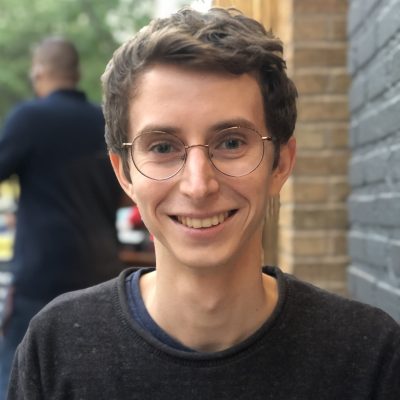
Alex, tell us something about yourself: where you grew up, went to college, grad school, family, etc.
I grew up near Houston, Texas, but I'm originally from the UK. I was born in England and my parents are Scottish; I quickly lost my English accent when I moved to Texas. A fun fact - there is an unusual abundance of philosophers from the part of Texas I grew up in. Jimmy and I grew up in the same exact neighborhood. And David Builes (Assistant Prof at Princeton) and I went the same middle school. There's something in the water in Sugar Land, Texas!
Give us an idea of your philosophical interests.
A common thread in my research is the question of how to understand probabilities. I am interested in that question at several different levels. One is how probabilities should be axiomatized or formalized. Some of my work looks at the details of Kolmogorov's axiomatization and competing axiomatizations, and explores how they fare in extreme cases, say, involving events of measure zero. Another level is how to understand probabilities in science, not just in physics but any area where there seems to some sort of "objective probability". What characterizes objective probabilities? Are they metaphysically unified or are they best characterized by their predictive or explanatory roles? What is the relationship between these probabilities and laws of nature? Can probabilities of physics and those of other sciences, like chemistry and biology, be unified under a single account of objective chance? Is there something special about quantum probability? Yet another level concerns the use of probability in statistical inference and in theories of epistemic rationality. Big picture, one thing I'm very interested in is how these different levels interact with one another. For example, one might think how we should axiomatize or formalize probability depends on the type of probability (objective, subjective) we are modeling. But on the hand, it's natural to think certain bridge principles hold between different kinds of probability; for instance, we should conform our subjective probabilities to known objective probabilities. But if there isn't a single framework that models both types of probability, how do we state those principles? I'm interested in these larger questions about probability.
Another part of my research in philosophy deals more directly with the philosophy of physics. We are arguably in the midst of the "second quantum revolution" — the development of quantum information theory and its application to quantum computers. Is this revolution just a practical one, or does it have important upshots for our understanding of quantum theory? This is one my long-term projects.
What got you into philosophy in the first place?
I already mentioned a possible causal explanation - being from Sugar Land, Texas. More seriously, I think two things got me into philosophy as a physics major in college. The first is that I took an epistemology course with Josh Schechter. I remember being very impressed by how much progress philosophers had made on what seemed like unworkably general questions (I now realize this is not a very common reaction to have to philosophy), and how helpful Josh's clarifications and distinctions were. The second thing that happened is that I took a philosophy of quantum mechanics class with Nina Emery. In the subsequent summer I helped Nina research and create a course in philosophy of time. Those experiences made me realize I might want a career in philosophy. At the end of that summer I decided not to pursue graduate school in physics and to pursue graduate school in philosophy instead.
If you were to name one philosphical question that most interests you, what would it be?
This is not a traditional philosophical question but... I would love an answer to the question of how we should interpret quantum mechanics. This is my favorite topic to teach, but I don't have an answer. Perhaps one day, one of my students will convince me of one.
What do you like to do when you’re not doing philosophy?
During the pandemic I started playing the bass guitar and I've been enjoying that since. By nature of the pandemic (and my being a novice!) I haven't gotten to play much with other people, so I'm hoping that I'll find some people to play music with here in Madison. If any readers know of good spots to meet musicians, let me know!