Data Science Updates is the University of Wisconsin-Madison's resource for news, training, events, and professional opportunities in data science, brought to you by the Data Science Institute, powered by American Family Insurance, and the Data Science Hub.
September 17, 2025
|
|
|
|
This fall, the Data Science Institute is assuming responsibility for a new, campus-wide effort called the RISE-AI Collaboration HQ. As the RISE Initiative moves from initial hiring to implementing its vision for research, education, and engagement, the RISE-AI Collaboration HQ will connect new RISE faculty with existing campus networks advancing scholarship in the field of artificial intelligence.
DSI Director Kyle Cranmer will lead the RISE-AI Collaboration HQ and convene a team to guide and support its activities. This group will catalyze research communities centered on innovative focus areas and build connections among UW–Madison’s AI community, which includes the more than 35 new RISE-AI hires and current faculty, staff, and students.
|
|
|
|
This summer, UW–Madison joined the AI Alliance, an international community of developers, researchers, industry leaders, and advocates who collaborate to advance safe, responsible AI rooted in open innovation. Through member-driven working groups, this alliance aims to collaboratively and transparently address the challenges of generative AI and democratize its benefits.
"At the University of Wisconsin–Madison, we believe that the future of AI must be grounded in openness, trust, and scientific rigor,” says Kyle Cranmer, director of the Data Science Institute. “Membership in the AI Alliance aligns with our commitment to the Wisconsin Idea: that research and innovation should benefit everyone."
|
|
|
|
|
September 18, 5:30 p.m. - 7:00 p.m.; 2257 College Library & Zoom. The free, open-source programming language R has become one of the most widely used tools for data analysis and statistical computing today. This workshop introduces learners to the basics of the language, the RStudio development environment, and some of the most common functions, packages, and tools in the R ecosystem.
|
|
|
|
September 18, 1:00 p.m. - 3:00 p.m.; 4218 Sewell Social Sciences. MaxQDA is a popular qualitative data analysis software that allows for organization, storage, coding, and analysis of qualitative data, including text, images, and video. This course will introduce the MaxQDA interface and cover the following topics: importing and cleaning data, organizing your project, coding data, and tools for performing data analysis.
|
|
|
|
September 19, 10:00 a.m. - 12:00 p.m.; Zoom. This workshop is for beginners who want to slowly walk through the process of starting with R, a programming language commonly used for data analysis. The session will introduce you to the RStudio interface for coding in R. We will work through setting up a project directory, covering key concepts and terminology, and loading and inspecting a dataset. This workshop is for programming novices, so no previous experience is required.
|
|
|
|
September 22, 5:30 p.m. - 7:00 p.m.; 2538 Morgridge Hall & Zoom. This course teaches object-oriented programming (OOP) and its corresponding syntax in Python. By the end of this course, the learner will be able to use OOP to more efficiently accomplish programming tasks, install external Python modules, and create their own Python modules. Learners should have have a basic understanding of procedural programming in Python.
|
|
|
|
September 23, 10:00 a.m. - 12:00 p.m.; Zoom. This workshop is for the absolute beginner wanting to slowly walk through the process of getting started with Python, a programming language commonly used for data analysis. We’ll work through the installation and setup of some helpful software, and we'll introduce basic concepts and terminology used in Python. Finally, we’ll create your first simple but useful program!
|
|
|
|
September 23, 1:00 p.m. - 3:00 p.m.; 4218 Sewell Social Sciences. NVivo is a popular qualitative data analysis software that allows for organization, storage, coding, and analysis of qualitative data, including text, images, and video. This course will introduce the NVivo interface and cover the following topics: importing data to NVivo, organizing and coding data, and performing analysis.
|
|
|
|
September 25, 5:30 p.m. - 7:00 p.m.; 2257 College Library & Zoom. Learn the basics of Visual Studio (VS) Code, a popular and highly customizable code editor. This workshop will walk through the basics of how to use VS Code, as well as installation of extensions and Git integration.
|
|
|
|
October 8, 2:30 p.m. - 4:30 p.m.; Orchard View Room (3820), Wisconsin Institute for Discovery. Learn how to use the Center for High Throughput Computing (CHTC) for genomics research. These monthly café sessions include mini tutorials, clinics, and one-on-one project assistance.
|
|
|
|
Have questions about anything data science-related? Come see the Data Science Hub facilitators at Coding Meetup on Tuesdays and Thursdays from 2:30-4:30 p.m. CT. To join Coding Meetup, join data-science-hubgroup.slack.com.
|
|
|
|
TODAY, September 17, 12:30 p.m. - 1:30 p.m.; Researcher's Link, Wisconsin Institute for Discovery AND Zoom. Join the Systems, Information, Learning, Optimization (SILO) group as they welcome electrical and computer engineering professor Grigorios Chrysos to present his talk Forgetting Sensitive Data on Open-Weight Models with Guarantees. This talk centers around the idea of privacy, and how to train machine learning models on sensitive data without risking inaccurate predictions.
|
September 19, 4:00 p.m.; Henry Vilas Park. Come one, come all! Inviting all students, staff, faculty, and friends to the annual CS Fall Picnic!
|
September 30, 12:00 p.m. - 1:30 p.m.; Zoom. Gain the foundational knowledge to understand and adapt to how generative AI is changing teaching and learning. We’ll explain core concepts, discuss opportunities and risks, and explore UW–Madison enterprise AI tools, including the newest addition, NotebookLM. Hear from specialists in DoIT Academic Technology, Libraries, Writing Across the Curriculum, and CTLM.
|
September 30, 8:00 a.m. - 4:30 p.m.; Union South. Hosted by Amazon Web Services (AWS), the State, Local, and Education Learning Day is a free opportunity for professionals and educators to learn more about how to implement AI, machine learning, data analytics, and cloud fundamentals into their practices.
|
October 8, 11:45 a.m. - 2:30 p.m.; 3110A Health Sciences Learning Center. Hear about the intersection between medicine and physics from Dr. Majid Afshar and Dr. Kyle Cranmer. This seminar includes a panel discussion and poster session to showcase current AI-related projects across UW, with the goal of further developing solutions to healthcare challenges using artificial intelligence. For more information or to register, visit the event's website.
|
|
|
|
October 10, 3:30 p.m.; Wisconsin Institute for Discovery. Now in it's third year, La Vaporera: Ciencia y Arte en Español is an exciting opportunity to learn about the intersection between science and art, in partnership with the Wisconsin Science Festival during Latine Heritage Month. There will be lightning talks, a keynote panel, and a special film showing.
|
|
|
|
|
|
|
DATA VISUALIZATION OF THE WEEK
|
|
|
|
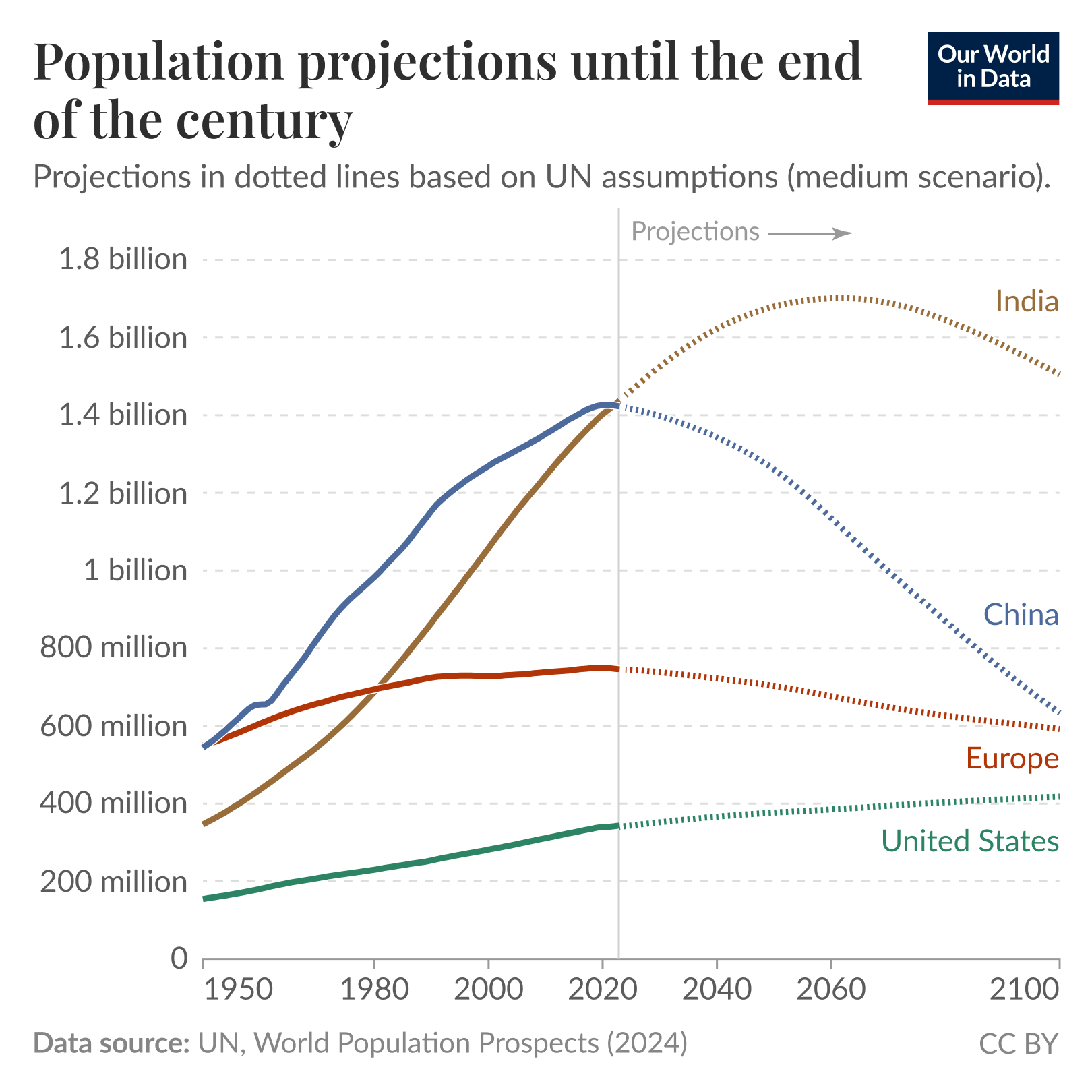
The populations of India, China, Europe, and the United States currently account for about half of the world's total population. However, these populations fluctuate constantly due to changes in birth rates, life expectancy, and migration worldwide. This chart visualizes the United Nation's prediction of the population of these four places through the end of the century. They project substantial differences in population size over the next 75 years, including China's population nearly halving.
|
|
|
|
Reposted from Our World in Data: Research and data to make progress against the world’s largest problems.
|
|
|
|
Data Science Updates is a collaborative effort of the Data Science Institute and Data Science Hub. This newsletter was originally created by the Data Science Hub and published as Hub Updates.
Use our submission form to send us your news, events, opportunities and data visualizations for future issues.
|
|
|
|
|