Data Science Updates is the University of Wisconsin-Madison's resource for news, training, events, and professional opportunities in data science, brought to you by the Data Science Institute, powered by American Family Insurance, and the Data Science Hub.
October 1, 2025
|
|
|
|

|
BadgerCompute is a Jupyter-based interactive service for academic and research computing at UW–Madison. With BadgerCompute, anyone with a NetID can:
- Develop code and scripts for research in their preferred programming language.
- Test scripts and programs using standard software.
- Explore, visualize, and interact with data and plots directly in a notebook.
Launch BadgerCompute right from your browser—no extra downloads or installations are needed. To get started, visit badgercompute.wisc.edu.
|
|
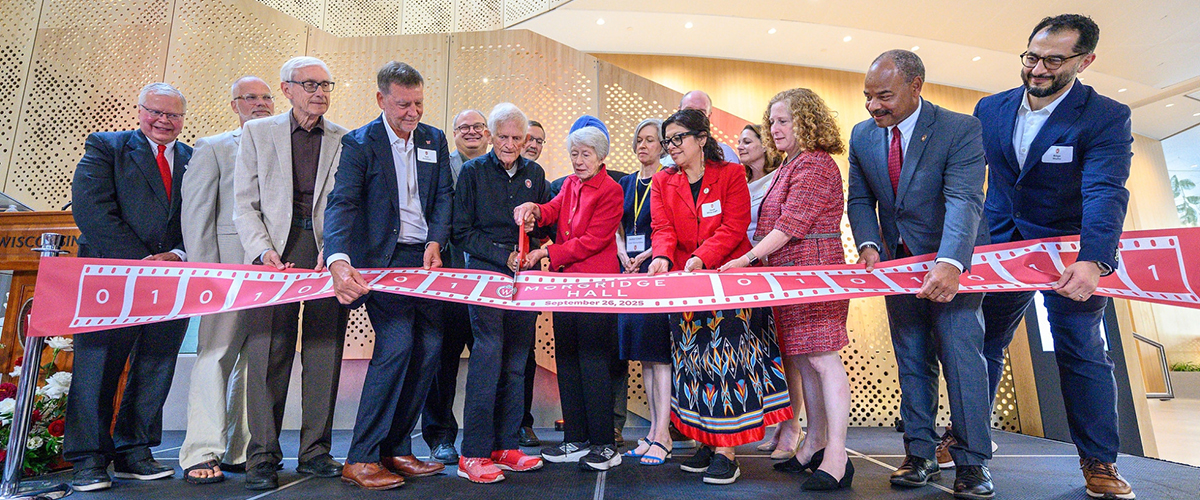
Morgridge Hall is envisioned as a hub for central campus, and with thousands of students, staff and faculty using this new space in its first month, the building has already lived up to this potential. At last Friday’s ribbon-cutting ceremony, Tashia Morgridge noted that each floor of the building represents new opportunities, new insights, and new friends and collaborators. Tashia and her husband John Morgridge were lead donors in supporting the construction of this new home for the School of Computer, Data, & Information Sciences, the Data Science Institute, the Department of Biostatistics and Medical Informatics, and the Center for High Throughput Computing.
|
|
|
|
October 8, 2:30 p.m. - 4:30 p.m.; Orchard View Room (3820), Wisconsin Institute for Discovery. Learn how to use the Center for High Throughput Computing (CHTC) for genomics research. These monthly café sessions include mini tutorials, clinics, and one-on-one project assistance.
|
October 15, 9:30 a.m. - 4:30 p.m.; 1360 Biotechnology Center. Use basic Linux skills to develop Next Generation DNA Sequencing (NGS) data analysis skills. This workshop focuses on analyzing data to identify single nucleotide polymorphisms (SNP), as well as visualizing results. This workshop is part two of the Fall 2025 Next Gen. Data Analysis workshop series .
|
October 20 - 23; Pyle Center. Join the Computational Modeling in Biology Network (COMBINE) in a multi-day workshop event hosted at UW-Madison. The workshop consists of talks, breakout meetings, and posters, with the goal of connecting experimental and theoretical systems biologists with COMBINE community of standards developers.
|
October 22, 9:30 a.m. - 4:30 p.m.; 1360 Biotechnology Center. Learn the principles behind (bulk) mRNA-Seq analysis with a hands-on introduction to Linux-based open source software and analysis pipelines for mRNA-Seq. Participants are expected to have a basic knowledge of the Linux environment and a basic understanding of statistical methods. This workshop is part three of the Fall 2025 Next Gen. Data Analysis workshop series.
|
|
|
|
Have questions about anything data science-related? Come see the Data Science Hub facilitators at Coding Meetup on Tuesdays and Thursdays from 2:30-4:30 p.m. CT. To join Coding Meetup, join data-science-hubgroup.slack.com.
|
|
|
|
dotData Club: Infer-X Kickoff Meeting
October 1, 5:45 p.m.; B2590 Morgridge Hall. Stop by this Wednesday as David Ertl, Executive Director of the N+1 Institute, launches the Infer-X program! Infer-X is a new program, within the EDGE Computing Lab, available to graduate and undergraduate students. Experiment with Qualcomm Edge hardware and SDKs to build AI Inference apps (video, sensors, AR/VR, etc.). This is a great opportunity for anyone interested in AI, IoT, robotics, or edge computing.
|
October 1, 12:30 p.m. - 1:30 p.m.; Orchard View Room, Wisconsin Institute for Discovery. Join the Systems, Information, Learning, Optimization ( SILO) group for "First-Order Algorithms for Large-Scale Optimization," hosted by Professor Jiawei Zhang of the computer sciences department. This talk will center around two main questions: In the constrained setting, is it possible to design algorithms that achieve the same convergence rate as GD and SGD? And, when Lipschitz smoothness or curvature varies significantly, how can we design adaptive algorithms? For the latter, we will focus specifically on the recently popular algorithm for LLM reasoning called GRPO.
|
October 6, 4:00 p.m.; 7560 Morgridge Hall. Join Professor Remco Chang from the Department of Computer Science at Tufts University for "A Visualization is Worth a Thousand Queries: Towards a Foundation for Reasoning in Visual Analytics." In this talk, Chang will uncover the foundation of visual analytics, framing visualization in terms of functions, spaces, and grammar, and offering a perspective aimed at formalizing how visualizations mediate between data, analytic tasks, and reasoning. All professionals and students interested in understanding more about data visualization are invited to attend.
|
October 8, 11:45 a.m. - 2:30 p.m.; 3110A Health Sciences Learning Center. Hear about the intersection between medicine and physics from Dr. Majid Afshar and Dr. Kyle Cranmer. This seminar includes a panel discussion and poster session to showcase current AI-related projects across UW, with the goal of further developing solutions to healthcare challenges using artificial intelligence. For more information or to register, visit the event's website.
|
|
|
|
October 10, 3:30 p.m.; Wisconsin Institute for Discovery. Now in it's third year, La Vaporera: Ciencia y Arte en Español is an exciting opportunity to learn about the intersection between science and art, in partnership with the Wisconsin Science Festival during Latine Heritage Month. There will be lightning talks, a keynote panel, and a special film showing.
|
AI and Genomics Reading Group
October 10, 9:30 a.m. - 10:45 a.m.; 3610 Morgridge Hall. Join Sundus Keles and Kris Sankaran for a reading group on AI and genomics, hosted weekly on Fridays. For more information, join the email group here.
|
October 14, 10:00 a.m.; Zoom. Join Dr. Satish E. Viswanath of the Departments of Pediatrics and Biomedical Engineering at Emory University for his talk titled "The Case of the Hidden Signatures: Designing Imaging AI to Bridge Patterns, Predictions & Precision Medicine." This talk is part of the Machine Learning for Medical Imaging (ML4MI) seminar series.
|
|
|
|
|
|
|
DATA VISUALIZATION OF THE WEEK
|
|
|
|
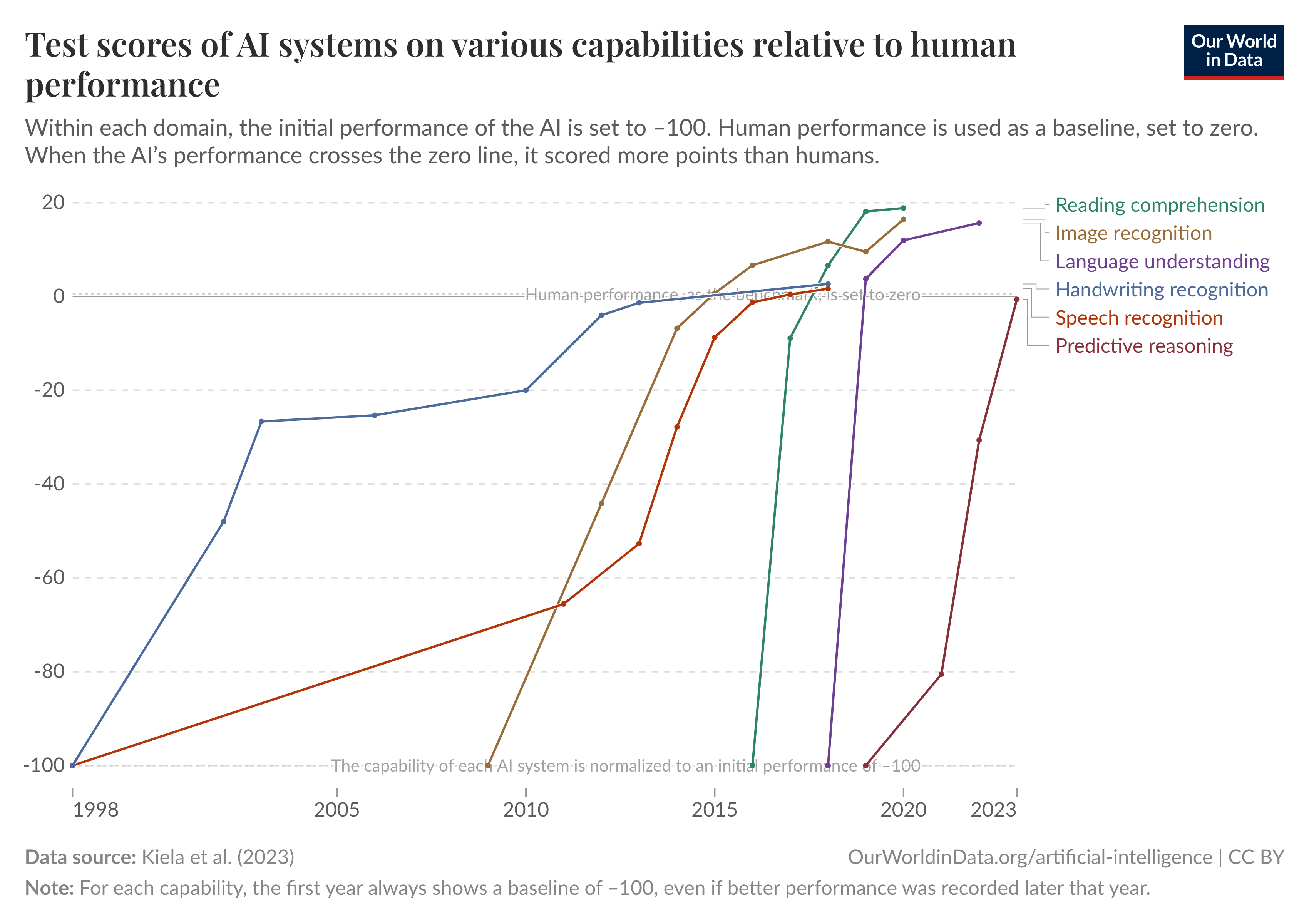
Artificial intelligence (AI) has become a very popular resource for students to use to create realistic, human-quality answers to homework and writing assignments. However, AI didn't always have such high performance. The following image is a data visualization summarizing the growth of different skills that AI has developed since 1998. Starting with speech and handwriting recognition, AI capabilities have expanded to include diverse skills. In particular, language understanding, image recognition, and reading comprehension have all grown to levels nearly 20% more accurate than humans. With the most recent implementation of predictive reasoning, it will be fascinating to see where these trajectories continue.
|
|
|
|
Reposted from Our World in Data: Research and data to make progress against the world’s largest problems.
|
|
|
|
Data Science Updates is a collaborative effort of the Data Science Institute and Data Science Hub. This newsletter was originally created by the Data Science Hub and published as Hub Updates.
Use our submission form to send us your news, events, opportunities and data visualizations for future issues.
|
|
|
|
|