Data Science Updates is the University of Wisconsin-Madison's resource for news, training, events, and professional opportunities in data science, brought to you by the Data Science Institute, powered by American Family Insurance, and the Data Science Hub.
October 15, 2025
|
|
|
|
|
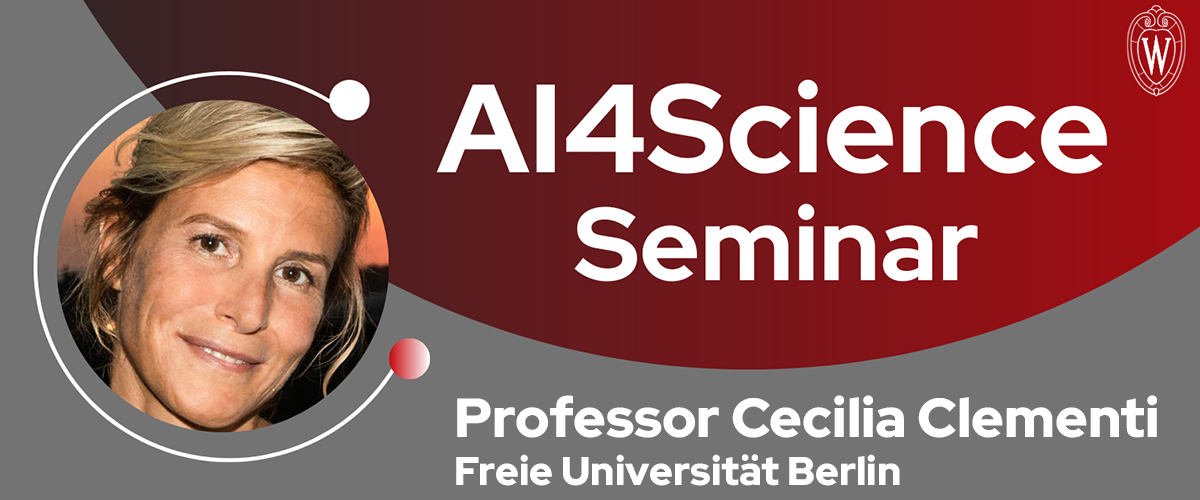
Join the Department of Chemistry and the Data Science Institute for an AI for Science seminar on protein modeling with Professor Cecilia Clementi on October 20, 4pm in the Chemistry Learning Studio (room 1435). Clementi is Einstein Professor of Physics at Freie Universität (FU) Berlin, Germany. Her research focuses on the development and application of methods for modeling complex biophysical processes by means of molecular dynamics, statistical mechanics, coarse-grained models, experimental data, and machine learning. Her talk will be preceded at 2:30pm by Dr. Frank Noé’s Hirschfelder Prize seminar on Molecular Science in the Age of AI.
|
The Open Source Program Office (OSPO) is looking for meaningful open-source projects and faculty / staff mentors for the spring 2026 cohort of our internship program. Project mentors direct and support interns’ activities. OSPO recruits, hires, and matches interns with projects, and it supports student interns with onboarding, weekly check-ins, and professional development opportunities. This is a fantastic opportunity for your project to receive valuable support.
Examples of internship projects include open-source research hardware and software development or creating documentation for existing research software. If you have an open-source project that could benefit from a dedicated student contributor, we invite you to submit a proposal by Friday, October 31.
|
The second annual Wisconsin RISE Initiative summit on November 17, 10am-2pm at the Wisconsin Union, is an opportunity to learn about the initiative’s progress over the past year and what’s to come in the months ahead. The event will include a plenary session featuring campus leaders followed by breakout sessions on each of the initiative’s three focus areas: RISE-AI, RISE-EARTH, and RISE-THRIVE. Please register for this event.
|
What are the ethics of artificial intelligence? What will be the long-term impact on our society as governments embrace these tools? These are the types of questions that will be investigated by the new Center for Humanistic Inquiry into AI and Uncertainty, housed in the Institute for Research in the Humanities. The National Endowment for the Humanities recently awarded funding to this effort, which is co-led by Associate Dean Grant Nelsestuen and Professor Steven Nadler.
This new center has announced its first annual competition for faculty fellowships. Applications are due this Friday, 10/17. For more information, visit the IRH fellowships page and scroll down to “UW-Madison Faculty Fellowships in AI and Knowledge” and “AI and Knowledge Fellowship.”
|
|
|
|
October 15, 9:30 a.m. - 4:30 p.m.; 1360 Biotechnology Center. Use basic Linux skills to develop Next Generation DNA Sequencing (NGS) data analysis skills. This workshop focuses on analyzing data to identify single nucleotide polymorphisms (SNP), as well as visualizing results. This workshop is part two of the Fall 2025 Next Gen. Data Analysis workshop series .
|
October 17, 10:00 a.m. - 12:00 p.m.; Online. One way to automate your reports is to create files with human readable text and machine readable code. This workshop will cover creating reproducible reports of this type in RStudio using Quarto. After this session, you will be able to create Quarto documents, add formatted text and executable code blocks, and render the document into a final report. A working knowledge of R and RStudio would be helpful for you to get the most out of this session.
|
October 20 - 23; Pyle Center. Join the Computational Modeling in Biology Network (COMBINE) in a multi-day workshop event hosted at UW-Madison. The workshop consists of talks, breakout meetings, and posters, with the goal of connecting experimental and theoretical systems biologists with COMBINE community of standards developers.
|
October 21, 8:30 a.m. - 4:30 p.m.; 3139 Computer Sciences. Join the Research Cyberinfrastructure team for Amazon web services (AWS) research day. This one-day workshop will highlight AWS services for managing infrastructure in AWS, machine learning (SageMaker Studio), Generative AI, data storage in AWS, and transfers using Globus. Presenters from AWS and UW–Madison will provide details about how these and similar tools are being used and how you can get started using them. You will also learn about UW–Madison initiatives designed to help reduce the cost of cloud computing, including the NIH STRIDES program for biomedical researchers.
|
October 22, 10:30 a.m. - 11:30 a.m.; 3610 Morgridge. Join CHTC facilitators and other researchers on campus for a hands-on workshop on high throughput computing. In this hands-on session, researchers will practice how to transfer data, submit jobs, and debug simple job errors on CHTC’s High Throughput Computing system.
|
October 22, 9:30 a.m. - 4:30 p.m.; 1360 Biotechnology Center. Learn the principles behind (bulk) mRNA-Seq analysis with a hands-on introduction to Linux-based open source software and analysis pipelines for mRNA-Seq. Participants are expected to have a basic knowledge of the Linux environment and a basic understanding of statistical methods. This workshop is part three of the Fall 2025 Next Gen. Data Analysis workshop series.
|
October 31, 10:00 a.m. - 12:00 p.m.; Online This workshop teaches learners to use RStudio and Git to keep track of file versions, host version controlled files on the campus GitLab instance, and synchronize your files between different computers. Individuals with a UW NetID and a working knowledge of R and RStudio will get the most out of this workshop.
|
|
|
|
Have questions about anything data science-related? Come see the Data Science Hub facilitators at Coding Meetup on Tuesdays and Thursdays from 2:30-4:30 p.m. CT. To join Coding Meetup, join data-science-hubgroup.slack.com.
|
|
|
|
dotData Club: Guest Speaker Hunter Rehm
October 15, 6:00 p.m.; 2532 Morgridge Hall. Join us for a special meeting with Hunter Rehm from Valuation Resource Company. Hunter will share insights into the Private Equity side of programming and data science, discussing how these skills connect to the world of finance. He will also talk about his career experiences and provide a look into what it’s like working in the finance industry, offering useful perspectives for anyone interested in data-driven roles or financial analysis. Don’t miss this chance to learn from Hunter’s experiences at the intersection of finance, data, and technology.
|
October 15, 12:30 p.m. - 1:30 p.m.; DeLuca Forum, Wisconsin Institute for Discovery. Join the Systems, Information, Learning, Optimization ( SILO) group for "Decision-Aware Models for Adaptive Experimentation and Bayesian Optimization" hosted by Assistant Professor Geoff Pleiss of the Department of Statistics at the University of British Columbia. Dr. Pleiss will discuss two recent works on decision-aware models for Bayesian optimization, a framework for adaptive experimentation widely used for hyperparameter tuning, robotics, and drug discovery.
|
|
|
|
AI and Genomics Reading Group
October 17, 9:30 a.m. - 10:45 a.m.; 3610 Morgridge Hall. Join Sundus Keles and Kris Sankaran for a reading group on AI and genomics, hosted weekly on Fridays. For more information, join the email group here.
|
October 17, 12:00 p.m. - 1:00 p.m.; Zoom. Join the Center for Teaching, Learning, and Mentoring for the latest installment of their Exploring AI in Teaching series. Develop your critical AI awareness by discussing how ethical and instructional frameworks apply to generative AI. Ainehi Edoro, Ph.D., Vilas Early Career Professor and Constellations Mellon-Morgridge Professor, and Emily Hall, Ph.D., director of Writing Across the Curriculum, will guide us in considering approaches to AI in teaching with writing as well as how to “reimagine” writing assignments with and without AI.
|
October 17, 12:00 p.m. - 1:00 p.m.; 7560 Morgridge Hall. Join the Biostatistics and Medical Informatics Department in welcoming Grace Yi from Western Ontario University for their talk titled "Two Disciplines, One Mission - A Comparative View on Making Sense of Imperfect Data from Statistical Science to Machine Learning." Data imperfections, such as measurement error in predictors and label noise in supervised learning, are pervasive across domains. Dr. Yi will offer a brief comparative review of approaches in statistics and machine learning to address these imperfections, highlighting the importance of addressing data quality issues and developing strategies to mitigate their adverse effects on inference and prediction.
|
October 23, 1:00 p.m. - 2:00 p.m.; 7560 Morgridge Hall. Join the Statistics Seminar for Xuming He's talk Some Recent Developments in Expected Shortfall Regression. Expected shortfall, measuring the average outcome (e.g., portfolio loss) above a given quantile of its probability distribution, is a common financial risk measure. The same measure can be used to characterize treatment effects in the tail of an outcome distribution, with applications ranging from policy evaluation in economics and public health to biomedical investigations. We will discuss some recent developments in this area, with a focus on a new optimization-based semiparametric approach to estimation of conditional expected shortfall that adapts well to data heterogeneity with minimal model assumptions.
|
|
|
|
|
|
|
DATA VISUALIZATION OF THE WEEK
|
|
|
|
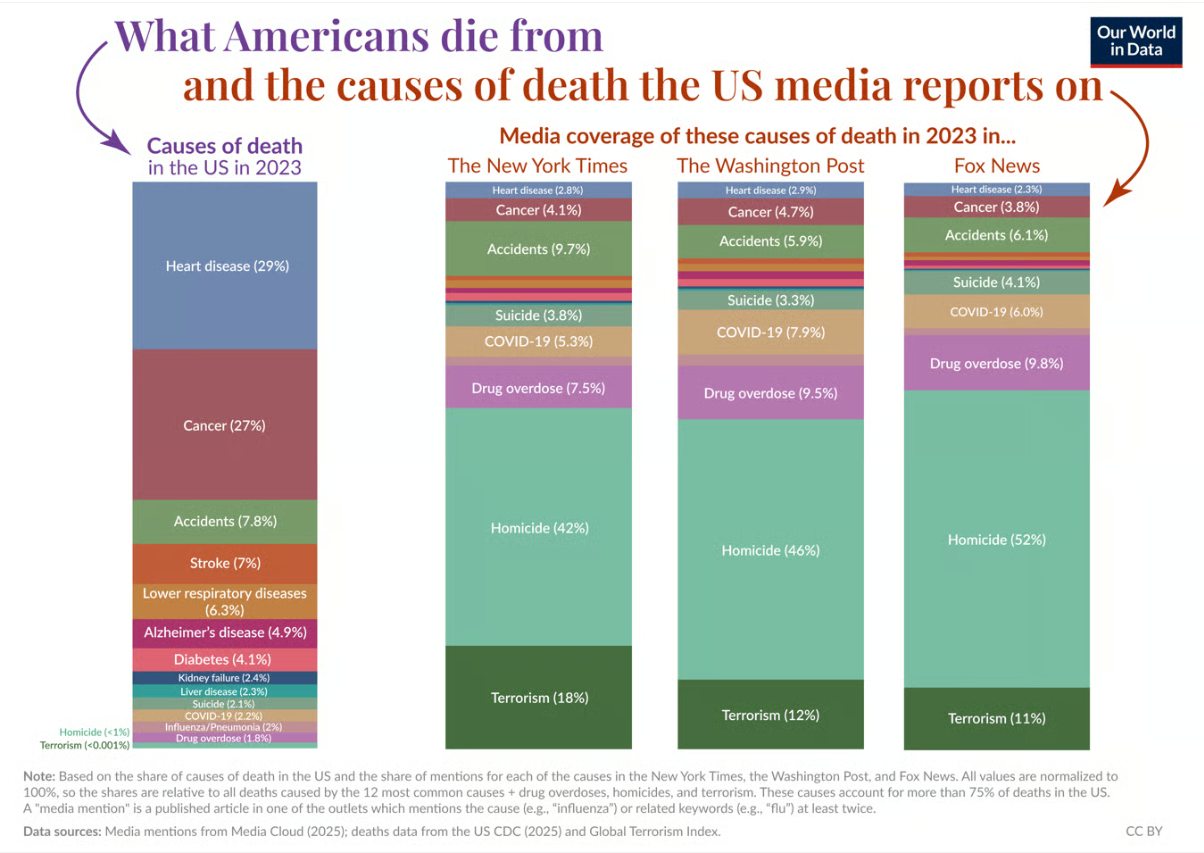
In general, people read the news because they want to know what is going on around them-- both things to look forward to and things to worry about, especially potential life-threatening situations. This begs the question of if news outlets accurately represent the whole picture of what's going on in the world, or if they are focused on some events over others. This data visualization shows the leading causes in death in Americans, in contrast to the most reported on causes of death by three major US media outlets. In actuality, health issues such as heart disease and cancer are far more fatal than you would expect based on the proportion of reporting done on them. Conversely, causes such as homicide and drug overdose are grossly overrepresented in media, which may lead people to think that they are causing many more deaths annually than they actually are.
|
|
|
|
Reposted from Our World in Data: Research and data to make progress against the world’s largest problems.
|
|
|
|
Data Science Updates is a collaborative effort of the Data Science Institute and Data Science Hub. This newsletter was originally created by the Data Science Hub and published as Hub Updates.
Use our submission form to send us your news, events, opportunities and data visualizations for future issues.
|
|
|
|
|