Data Science Updates is the University of Wisconsin-Madison's resource for news, training, events, and professional opportunities in data science, brought to you by the Data Science Institute, powered by American Family Insurance, and the Data Science Hub.
November 12, 2025
|
|
|
|
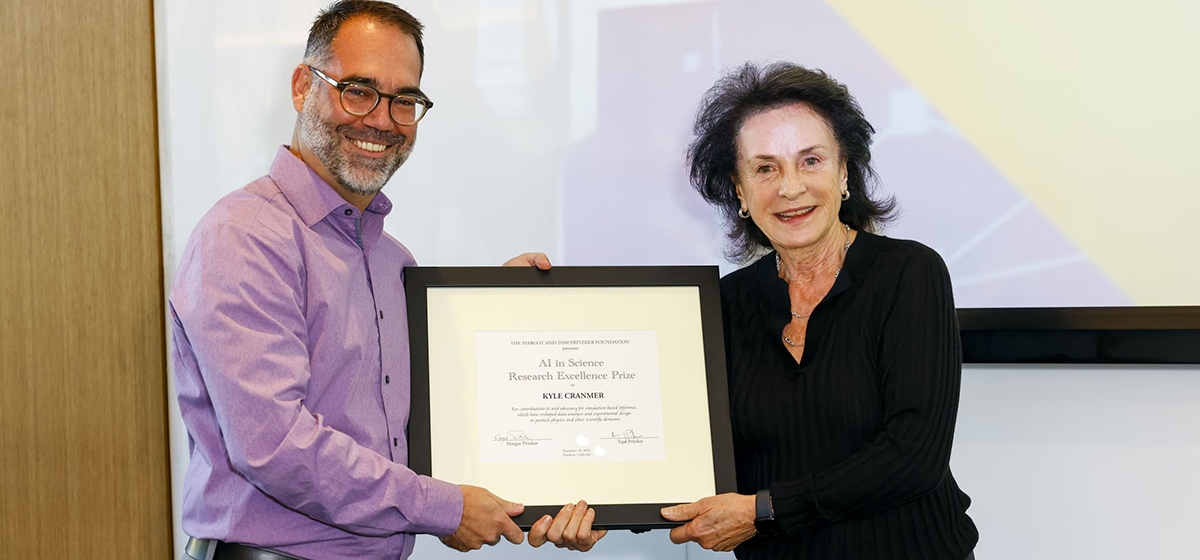
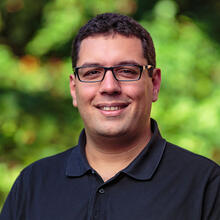
Kyle Cranmer, professor of physics and director of the Data Science Institute, has been honored with the inaugural Pritzker Prize in AI for Science for his role in establishing a powerful new approach to data analysis. The prize recognizes his contributions to and advocacy for simulation-based inference, which combines AI and computer simulations to enable statistical analysis of data in situations where it was not previously possible.
“For decades, scientists have had to limit the kinds of questions they ask because we didn’t have the methodology to be able to answer them,” says Cranmer. “This kind of dramatic improvement in capabilities allows us to go back to square one and start addressing the questions that we’ve wanted to ask for years.”
|
|
|
|
Join the Data Science Institute and the RISE-AI Collaboration HQ for a seminar with Dr. Zaid Harchaoui, professor of statistics at the University of Washington, on November 20, 4-5pm in the Morgridge Hall Seminar Room. In his talk, Dr. Harchaoui will describe zero-shot prediction, a new learning and prediction paradigm that can learn a highly predictive model without a collection of input-output data pairs for the task at hand, nor even a formal definition of the actual task. He will cover the origins of this approach, its latest incarnations in computer vision and language modeling, and current opportunities and challenges. Light refreshments will be served.
|
|
|
|
Have you ever accidentally written over the wrong file? Been plagued by mysterious errors no matter how many times you clean the data? This year’s Data Horror Story Contest, organized by UW-Madison Libraries and Research Data Services, asked the campus community to share their scariest data horror stories and cautionary tales and you did not disappoint! Read the winning story “ Ghost in the Drive” and the follow up blog with “ Even More Data Horror Stories” - if you dare!
|
|
|
|
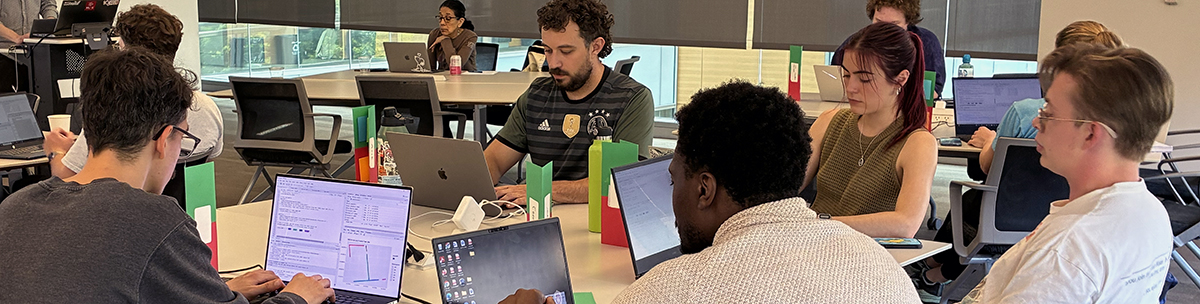
The Data Science Hub is seeking a Data Science Facilitator to help researchers learn and apply data science and software development in their work. Our team supports the research community through hosting and teaching Carpentries workshops, consulting with researchers on data science challenges, and building communities of practice where researchers learn from one another. If you’re passionate about empowering researchers and advancing data-driven discovery, we’d love to hear from you! See the position listing for more information. Apply by 12/1.
|
|
|
|
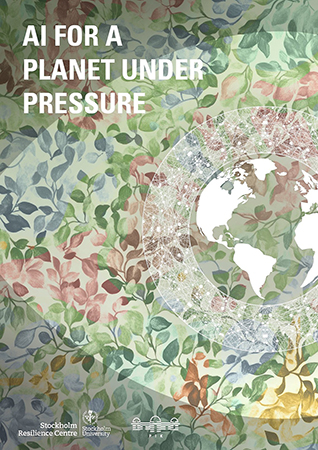
AI is reshaping almost every aspect of society and could also play a vital role in tackling environmental challenges. A new report from the Stockholm Resilience Centre and the Potsdam Institute for Climate Impact Research, with support from U.S. organizations including Google Deep Mind, highlights how AI can accelerate research on climate change, biodiversity loss, and other crises related to planetary boundaries. Beth Tellman, assistant professor in the Nelson Institute for Environmental Studies, co-authored this report.
|
|
|
|
November 14, 5:30 p.m. - 7:30 p.m.; Online. Python is a powerful, popular programming language that gets used for just about everything: basic coding, graphics processing, machine learning, AI, web scraping, data analysis, and much more. This workshop offers an introduction to basic Python concepts that will help you get coding in no time – no previous programming experience required! Topics include: writing and running scripts in Python, data types, variables and functions, calculations in Python, control flow, data structures, and Python’s standard library.
|
November 14, 9:30 a.m. - 4:30 p.m.; 1360 Biotechnology Center. This new workshop consists of lectures and hands-on training in the analysis and interpretation of shotgun metagenomic sequencing data. Participants will gain experience using modern tools to profile the composition of microbial communities and assessing their functional potential. Planned topics may include some of the following topics based on interest: metabolic potential of microbial communities (gene level or pathway level), prediction of antimicrobial resistance, and metagenome-assembled genomes.
|
November 18, 3-4:30 p.m., Gordon Commons Event Center. Curious about communicating your research in ways that resonate with non-federal funders? The Sustainability Research Hub, in partnership with the RISE-AI Collaboration HQ, Office of Business Engagement, and UW Foundation, is hosting a hands-on workshop for researchers looking to engage with new partners to secure non-federal support. The goal is for you to leave this event with concrete tools to engage potential sponsors effectively.
|
November 19, 9:30 a.m. - 4:30 p.m.; 1360 Biotechnology Center. This new workshop consists of lectures and hands-on training in the analysis of the shotgun metagenomics results from the previous workshop. This workshop is also suitable for the analysis of qiime2 results. Prerequisites include a basic understanding of R and statistical methods.
|
November 20 - 21, 9:00 a.m. - 3:00 p.m.; Virtual. This free and fully virtual workshop will focus on “Harnessing AI for Research, Learning, and Communicating”. The workshop welcomes researchers, students, postdocs, and faculty of all levels, across theoretical computer science, machine learning, and adjacent fields. Each of the workshop’s two sessions will include a “how-to” talk on using AI tools in research and learning, a hands-on activity to practice effective prompting and tool use, a panel discussion on tips, tricks, and the broader impact of AI in research, and a social hour with mentoring tables.
|
|
|
|
Have questions about anything data science-related? Come see the Data Science Hub facilitators at Coding Meetup on Tuesdays and Thursdays from 2:30-4:30 p.m. CT. To join Coding Meetup, join data-science-hubgroup.slack.com.
|
|
|
|
November 12, 12:30 p.m. - 1:30 p.m.; Researcher's Link, Wisconsin Institute for Discovery. Join the SILO group in welcoming Michael W. Mahoney from the University of California–Berkeley's Department of Statistics and the International Computer Science Institute (ICSI). Mahoney is also an Amazon Scholar as well as head of the Machine Learning and Analytics Group at the Lawrence Berkeley National Laboratory. His talk will focus on random matrix theory as well as the challenges and potential uses for it in machine learning and computing.
|
DotData Hosts Matthew Bruehl
November 12, 6:00 p.m.; 2532 Morgridge Hall. Join dotData for a talk with Matt Bruehl, UW-Madison alum and current senior engineer at NVIDIA. Matt will dive into his experience from graduation to how he got involved with big tech and NVIDIA. Matthew will present on AI in industry and how to prepare for the future with AI, covering key skills, trends, and what companies are looking for as AI continues to grow. This is a great opportunity to hear from someone who has successfully transitioned from UW to a leading tech role and to ask questions about careers, AI, and industry pathways.
|
November 14, 9:30 a.m. - 10:45 a.m.; 3610 Morgridge Hall. Join Sundus Keles and Kris Sankaran for a reading group on AI and genomics, hosted weekly on Fridays.
|
November 17, 11:10 a.m.; Zoom. Join Dr. Andreas Velten, associate professor at UW–Madison, for his talk Surgical Imaging Photon by Photon, hosted by the Machine Learning for Medical Imaging seminar series. This talk will focus on applications of single photon cameras and fluorescent methods to better understand medical samples.
|
November 21, 2:25 p.m.; 901 Van Vleck Hall. Join the Applied and Computational Math Seminar in welcoming Jessie Levillian from Centre National des Etudes Spatiales and INSA Toulouse for a talk titled Fokker-Planck based mathematical models for flagellar activation mechanisms.
|
November 21, 12:15 p.m. - 1:15 p.m.; 175 Science Hall. Join the GeoDS Lab@UW-Madison and UW–Madison's Data Science Institute in welcoming Dr. Zhiyong Zhou from the Swiss National Science Foundation (SNSF). His talk titled GeoAI-enabled multi-scale cartography: Progress and a research agenda will cover the latest research progress on GeoAI-enabled map generalization supported by SNSF.
|
|
|
|
|
|
|
DATA VISUALIZATION OF THE WEEK
|
|
|
|
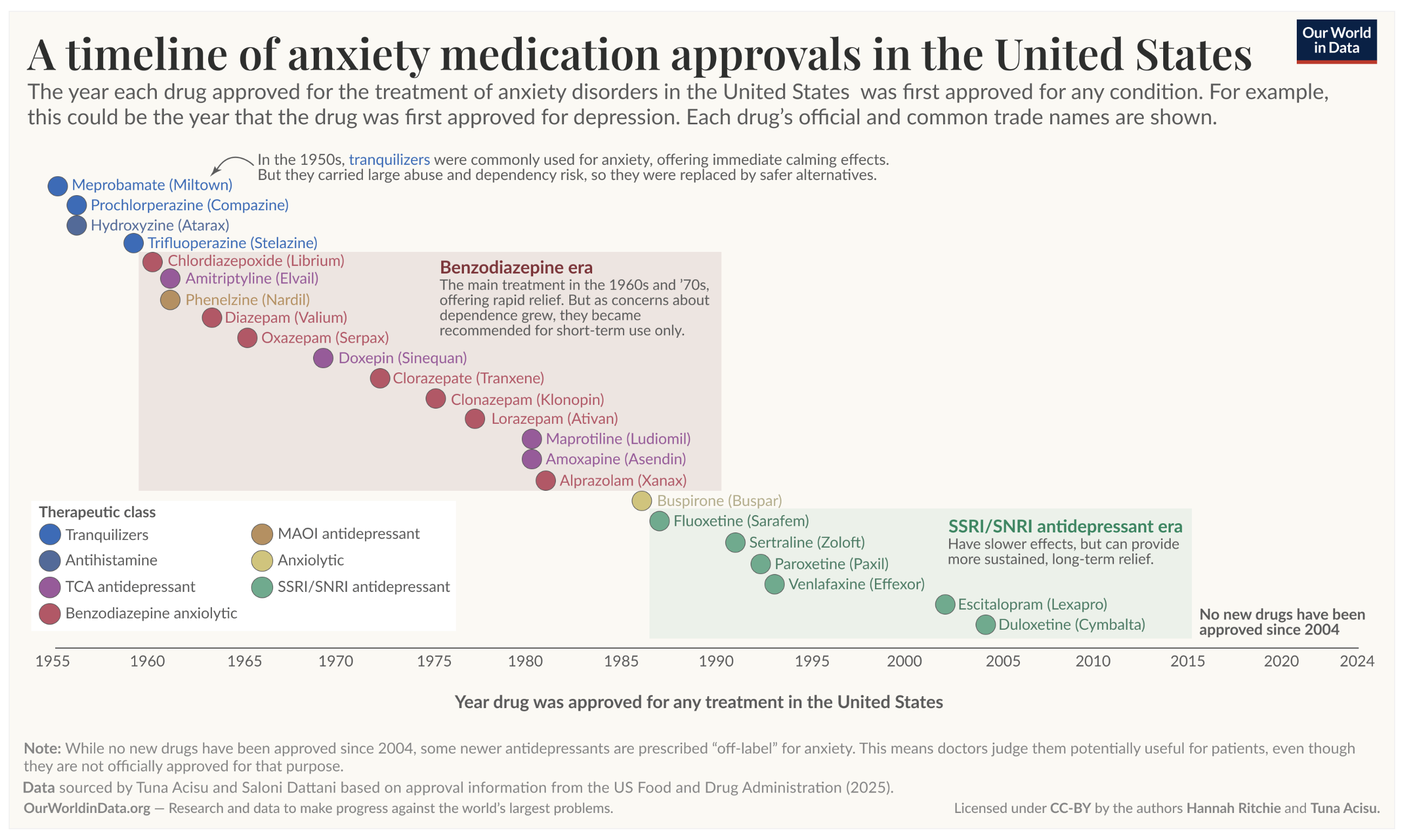
Anxiety is the world's most common mental health condition, with around 4% of the world population having anxiety. Since anxiety can have a strong impact on a person's day-to-day life, it is important to have healthy and effective treatment options. Since 1950, there have been three major categories of drugs developed to treat anxiety: tranquilizers, benzodiazepine, and antidepressants. The different drugs used throughout the years are visualized in the infographic below.
|
|
|
|
Reposted from Our World in Data: Research and data to make progress against the world’s largest problems.
|
|
|
|
Data Science Updates is a collaborative effort of the Data Science Institute and Data Science Hub. This newsletter was originally created by the Data Science Hub and published as Hub Updates.
Use our submission form to send us your news, events, opportunities and data visualizations for future issues.
|
|
|
|
|