Data Science Updates is the University of Wisconsin-Madison's resource for news, training, events, and professional opportunities in data science, brought to you by the Data Science Institute, powered by American Family Insurance, and the Data Science Hub.
November 26, 2025
|
|
|
|
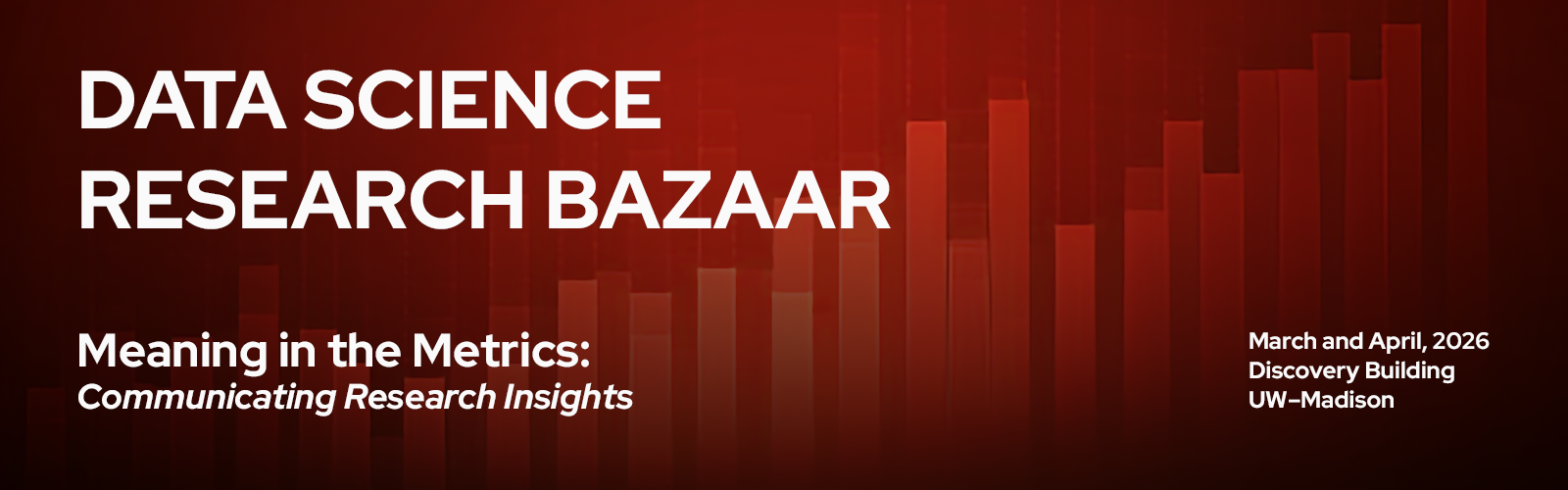
Researchers, students, and professionals are invited to submit proposals for the Data Science Research Bazaar. This annual UW–Madison conference brings together people from diverse fields who use data, computing, and software in their work. This year's theme—Meaning in the Metrics—highlights creative strategies for translating research into compelling formats.
Applicants can propose to present their work, either related to the theme or more broadly focused on data science and computation, at one or more Research Bazaar events. The main conference, with opportunities to present lightning talks and posters, will be on March 19. Trainings and focused discussions will be held on other dates in March and April. Proposals are due January 15.
|
A goal of the RISE-AI Collaboration HQ is to foster new research communities built around topical focus areas, and they are currently accepting applications to launch new groups. Multidisciplinary topics that bring many different perspectives to the table and include new RISE faculty are of particular interest. Selected incubator teams will undertake collaborative activities such as seminars, symposia, ideation sessions for early-stage research, and networking events. The RISE-AI Collaboration HQ will support activities for selected teams. Learn more about this initiative and propose a focus area on the new RISE-AI Collaboration HQ web page.
|
The UW–Madison Statistical Consulting Group is hosting a free workshop on experimental design on Thursday, December 4th, 4 to 5 pm in Morgridge Hall B2550. Researchers from all disciplines are invited, and affiliation with UW–Madison is not required. Steven Moen, statistics Ph.D. student, will present on Four Common Experimental Designs and How to Use Them. No prior statistical or coding experience is required. RSVP by Friday, November 28th at 5 pm.
|
|
|
|
Igniting Interdisciplinary Innovation (I³) is a campus-wide effort led by the Office of the Vice Chancellor for Research (OVCR) to catalyze bold research collaborations that complement UW–Madison’s RISE themes: AI, EARTH, and THRIVE. I³ will bring together researchers from across schools and colleges to develop high-impact, interdisciplinary projects that will advance solutions to complex societal challenges and position teams to attract significant extramural funding. Applicants are required to register for a topic-focused incubation session and submit an expression of interest by 12/23. Information sessions are being held in December. Learn more and sign up on the OVCR website.
|
|
|
|
December 8, 10:00 a.m. - 11:45 a.m.; Online. Ready to diagnose and strengthen your business financials? This hands-on course introduces the FinanceEDGE Tool—a structured, four-step framework designed to help small business owners analyze financial health, identify root causes of financial stress, and implement actionable solutions. Whether you’re facing rising costs, uneven cash flow, or stagnant revenue, this course equips you with the tools to move forward with clarity and confidence.
|
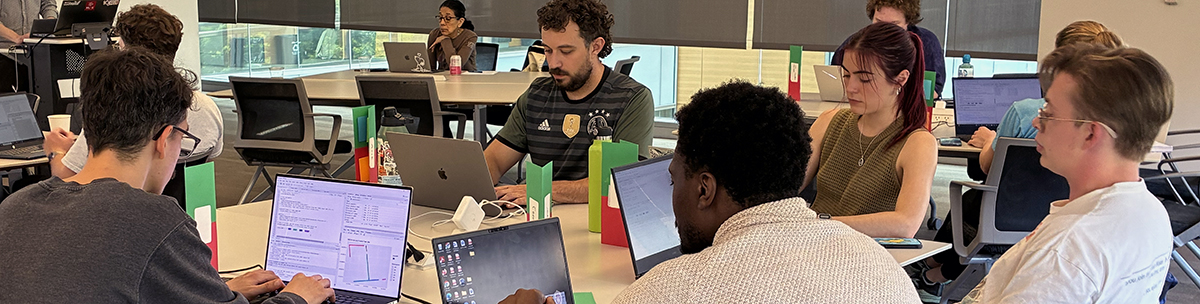
January 12-16, 9:00 a.m. - 1:00 pm; online. Software Carpentry aims to help graduate students and other researchers get their work done in less time and with less pain by teaching them basic research computing skills. This hands-on workshop will cover basic concepts and tools including program design, version control, data management, and task automation. Registration opens December 1.
|
|
|
|
Have questions about anything data science-related? Come see the Data Science Hub facilitators at Coding Meetup on Tuesdays and Thursdays from 2:30-4:30 p.m. CT. To join Coding Meetup, join data-science-hubgroup.slack.com.
|
|
|
|
November 26, 12:30 p.m. - 1:30 p.m.; Orchard View Room, Wisconsin Institute for Discovery. Join the SILO group in welcoming Professor Sanjay Shakkottai from UT Austin for his talk titled Towards discrete diffusion models for language and image generation. He will be discussing a new language generation model called the Anchored Diffusion Language Model and its applications.
|
December 1, 12:00 p.m.; 5406 Genetics Biotechnology Center or WIMR 2798 West Wedge. Join Dr. Audrey Gasch for her talk titled Adding dimensions: how to analyze genomic screens done across many genetic backgrounds. This seminar will be hosted both in-person and on Zoom, and followed by think-tank discussions intended to develop constructive solutions to genomics and precision medicine topics.
|
December 3, 10:00 a.m.; Zoom. Join Dr. Efrat Shimron, assistant professor at Technion – Israel Institute of Technology, for her talk AI-Driven Advances for Fast, Robust, and Affordable MRI, hosted by the Machine Learning for Medical Imaging seminar series. This talk will focus on developments in using machine learning for MRI examinations and data processing.
|
December 5, 9:30 a.m. - 10:45 a.m.; 3610 Morgridge Hall. Join Sundus Keles and Kris Sankaran for a reading group on AI and genomics, hosted weekly on Fridays.
|
|
|
|
|
|
|
DATA VISUALIZATION OF THE WEEK
|
|
|
|
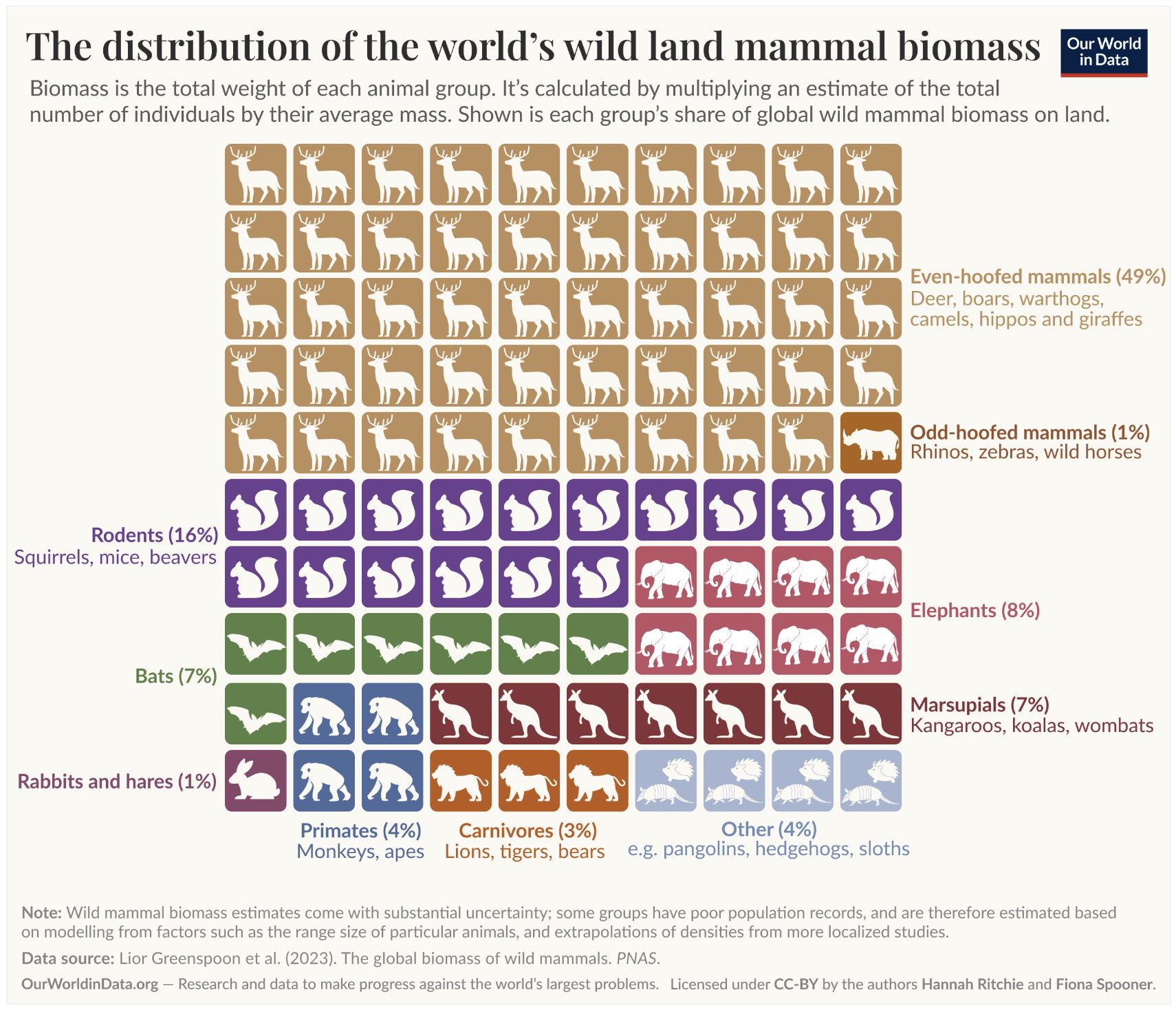
When considering Earth's mammals, 98% are either humans or livestock – leaving just around 2% of true wild mammals. When considering this population, it is important to focus on biodiversity. Having diverse mammal (and other animal) populations contributes significantly to the maintenance of ecosystems, since different animals perform different tasks. This data visualization considers biomass of each animal group instead of pure population size. As seen below, even-hoofed mammals (including deer, moose, and boar) make up nearly half of the world's wild land mammal biomass.
|
|
|
|
Reposted from Our World in Data: Research and data to make progress against the world’s largest problems.
|
|
|
|
Data Science Updates is a collaborative effort of the Data Science Institute and Data Science Hub. This newsletter was originally created by the Data Science Hub and published as Hub Updates.
Use our submission form to send us your news, events, opportunities and data visualizations for future issues.
|
|
|
|
|