Data Science Updates is the University of Wisconsin-Madison's resource for news, training, events, and professional opportunities in data science, brought to you by the Data Science Institute, powered by American Family Insurance, and the Data Science Hub.
February 18, 2026
|
|
|
|
|
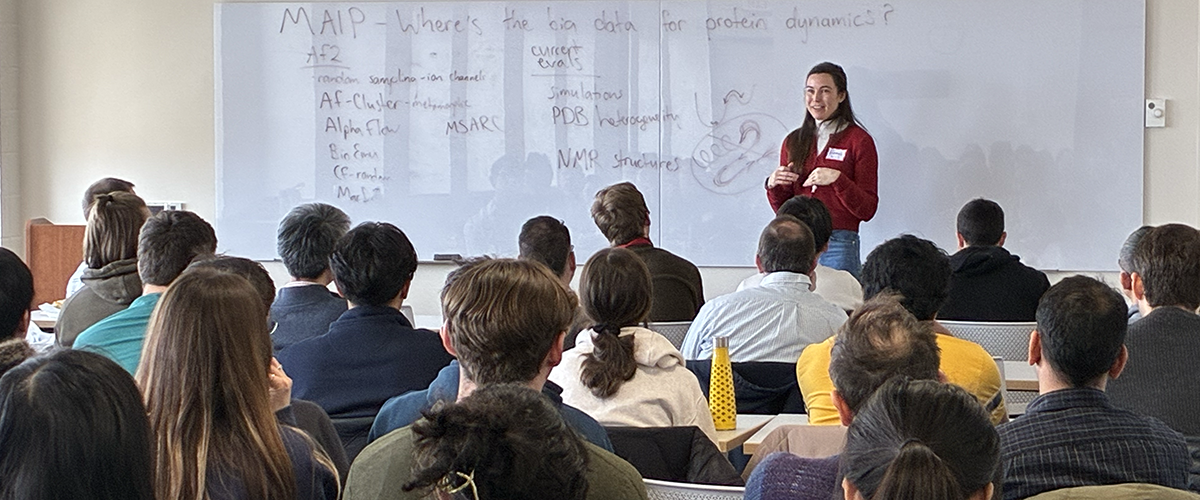
The room was packed on February 9 for the first in a series of chalk talks by Madison AI for Proteins (MAIP), an incubator team supported by the RISE-AI Collaboration HQ. MAIP is led by Hannah Wayment-Steele, a new RISE-AI hire in Biochemistry, and Anthony Gitter, Biostatistics and Medical Informatics / Morgridge Institute. Visit their website to learn more about their work and upcoming talks.
|
|
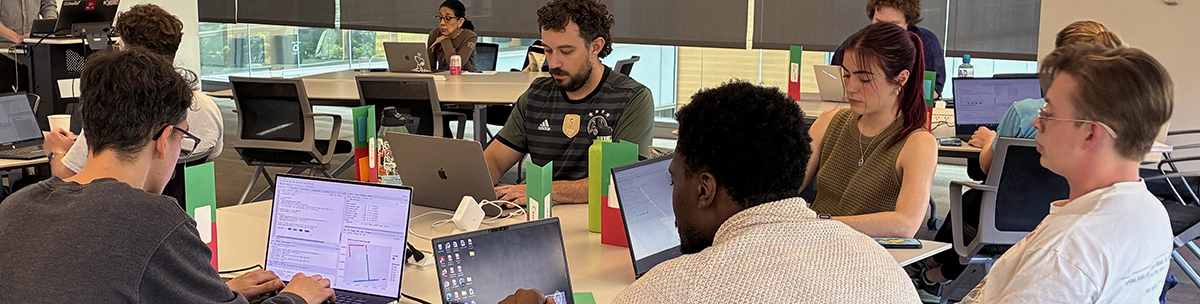
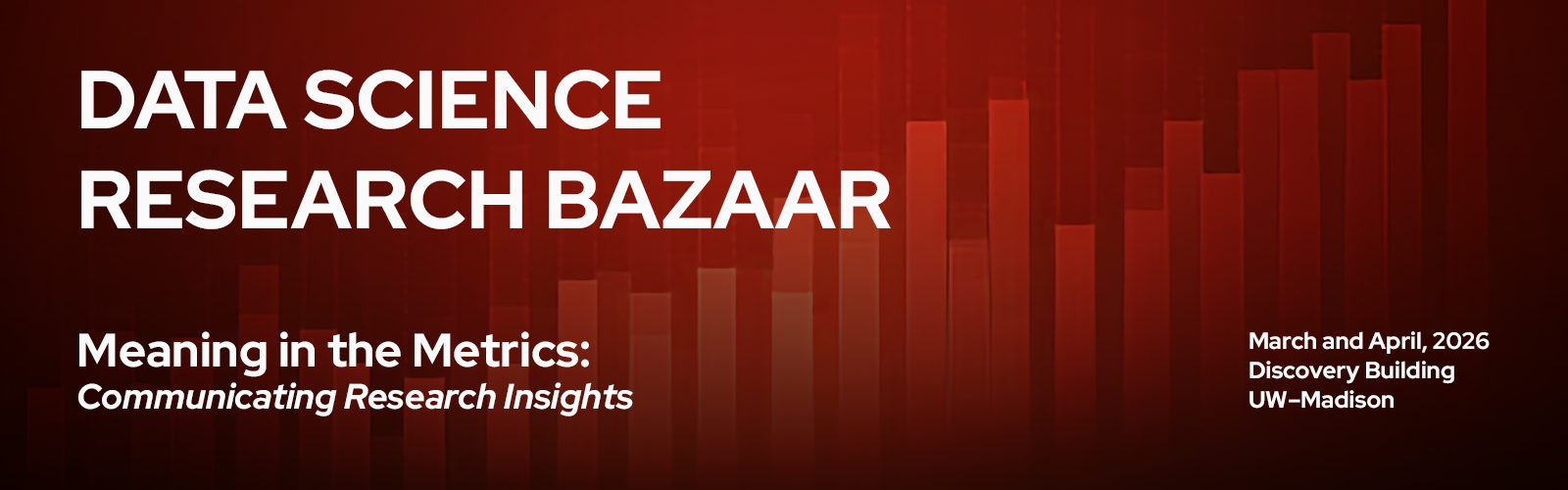
Calling all data enthusiasts! Registration is open for the UW–Madison Data Science Research Bazaar at the Discovery Building. The main Research Bazaar will take place on March 19, and it will include opening and closing talks, lightning talks, and a poster session. Additional trainings and focused discussions are scheduled throughout March and April, and you won’t want to miss the Data Story Slam on February 25.
The Research Bazaar is open to UW–Madison and the wider community. Whether you're a seasoned data scientist or just starting your journey, this event offers something for you. Register by March 5 and view the full schedule of events at the Research Bazaar website.
|
|
Digital Scholarship Hub Hosts Data Storytelling Events
|
|
|
|
How can data visualization techniques foster participation and empowerment in community settings? Join Professor Rahul Bhargava as he introduces arts-based approaches to working with data at two upcoming events hosted by the Digital Scholarship Hub:
- Data Storytelling Beyond the Visual (lecture): March 4, 4-5:30pm, Memorial Library 126
- Embodying Data: Telling Impactful Data Stories (workshop; registration required): March 5, 10am-noon, Memorial Library 224
|
|
|
|
Through case studies and examples, Bhargava will explore how we can create more inclusive, engaging, and action-oriented interactions with information through multi-sensory invitations. Bhargava leads the Data Culture Group as an assistant professor of Journalism and Art + Design at Northeastern University.
|
An autonomous experimentation platform at the Great Lakes Bioenergy Research Center is poised to accelerate discoveries that will harness the power of microbes to advance U.S. leadership in the developing bioeconomy. The AI-enabled platform, known as Proteus, will enable researchers to make quicker, smarter decisions when engineering microbes for biomanufacturing. UW–Madison is well positioned to leverage Proteus in partnership with national laboratories and DOE’s Genesis Mission to dramatically increase biological research productivity.
|
|
|
|
February 18, 9:00 a.m. - 11:00 a.m.; 1145 Discovery Building. Machine Learning (ML) + Coffee is a monthly meetup for the UW community to discuss ongoing ML or artificial intelligence projects, share ideas, and find new tools and approaches. ML + Coffee offers a supportive, casual environment across a broad variety of departments. Coffee is provided to keep the ideas flowing.
|
February 20, 9:00 a.m. - 10:30 a.m; Zoom. Titled Digitalization of agrifood supply chains, and the impact on social sustainability and fair value redistribution, Dr. Marco Formentini's talk is the first of a four-webinar series on how to use AI and computing to improve food distribution, marketing, and planning. This series will cover AI tools for food systems to explore ways to improve information exchange to reach public goals of resilience and fairness.
|
February 24, 6:00 p.m. - 7:00 p.m; Room 10, Agricultural Hall. Join the WISCIENCE community as they share how to get involved in undergraduate research on campus. This workshop includes information on how to find a mentor/lab and how to know if they are the right fit for your needs.
|
February 26, 8:45 a.m. - 4:30 p.m; Orchard View Room, Wisconsin Institute for Discovery. This workshop highlights Google Cloud services for managing infrastructure, machine learning, and generative AI. Presenters from Google and UW–Madison will provide details about how these and similar tools are being used and how you can get started using them. You will also learn about two UW–Madison initiatives designed to help reduce the cost of cloud computing. Lunch is included, and Zoom options are available.
|
|
|
|
Have questions about anything data science-related? Come see the Data Science Hub facilitators at Coding Meetup on Tuesdays and Thursdays from 2:30-4:30 p.m. CT. To join Coding Meetup, join data-science-hubgroup.slack.com.
|
|
|
|
February 20, 12:00 p.m. - 1:00 p.m.; Seminar Room, Morgridge Hall. Join Professor Didong Li from the Department of Biostatistics at the University of North Carolina for his talk titled Statistics in the Age of AI: Theory, Methods, and Data. This talk is hosted by UW's Department of Biostatistics and Medical Informatics seminar series. Anyone is welcome to join in person or on Zoom.
|
February 21, 9:00 a.m. - 5:00 p.m.; Morgridge Hall and Discovery Building. Hosted by the Wisconsin AI Safety Initiative and UW-Madison School of Computer, Data, and Information Sciences, this one-day symposium aims to bring together interdisciplinary experts AI's real-world impacts and trajectory. There will be two sessions, themed Where is AI today? and Where is AI going? An application is required .
|
February 21-22, 9:00 a.m.; 1310 Sterling Hall. MadData26 is a 24 hour, data-based hackathon focused on using data science techniques to solve a real-world issue in any discipline. Participants are responsible for creating a product that can solve practical problems, and data needs to be an essential aspect of their product. Final products include, but are not limited to: machine learning models, insights from statistical analysis, and business solutions based on predictive models. The competition will take place on February 21st and 22nd, 2026.
|
February 25, 4:30 p.m. - 6:30 p.m.; DeLuca Forum, Discovery Building. Visit or participate in the Data Story Slam, an informal social event where storytellers will share observations, surprises, predictions, aspirations, and other anecdotes about the ever-increasing presence of data in the world around us. Tell a short story about a futuristic vision, sing a data-related sendup of a favorite song, show off a personal discovery gleaned from app metrics, or recount a significant success or failure with your code in a supportive, inclusive space. Be a storyteller, or come to listen and encourage. This event is part of the 2026 Data Science Research Bazaar.
|
CGSI Genomic Seminar Series: Sushmita Roy
March 5, 1:30 p.m. - 2:30 p.m.; 1111 Genetics Biotechnology Center. Join the Center for Genomic Science Innovation (CGSI) in welcoming Sushmita Roy from the University of Wisconsin's Department of Biostatistics and Medical Informatics for her seminar titled Computational tools to examine dynamics of 3D genome organization and long-range gene regulation within and across species.
|
|
|
|
|
|
|
DATA VISUALIZATION OF THE WEEK
|
|
|
|
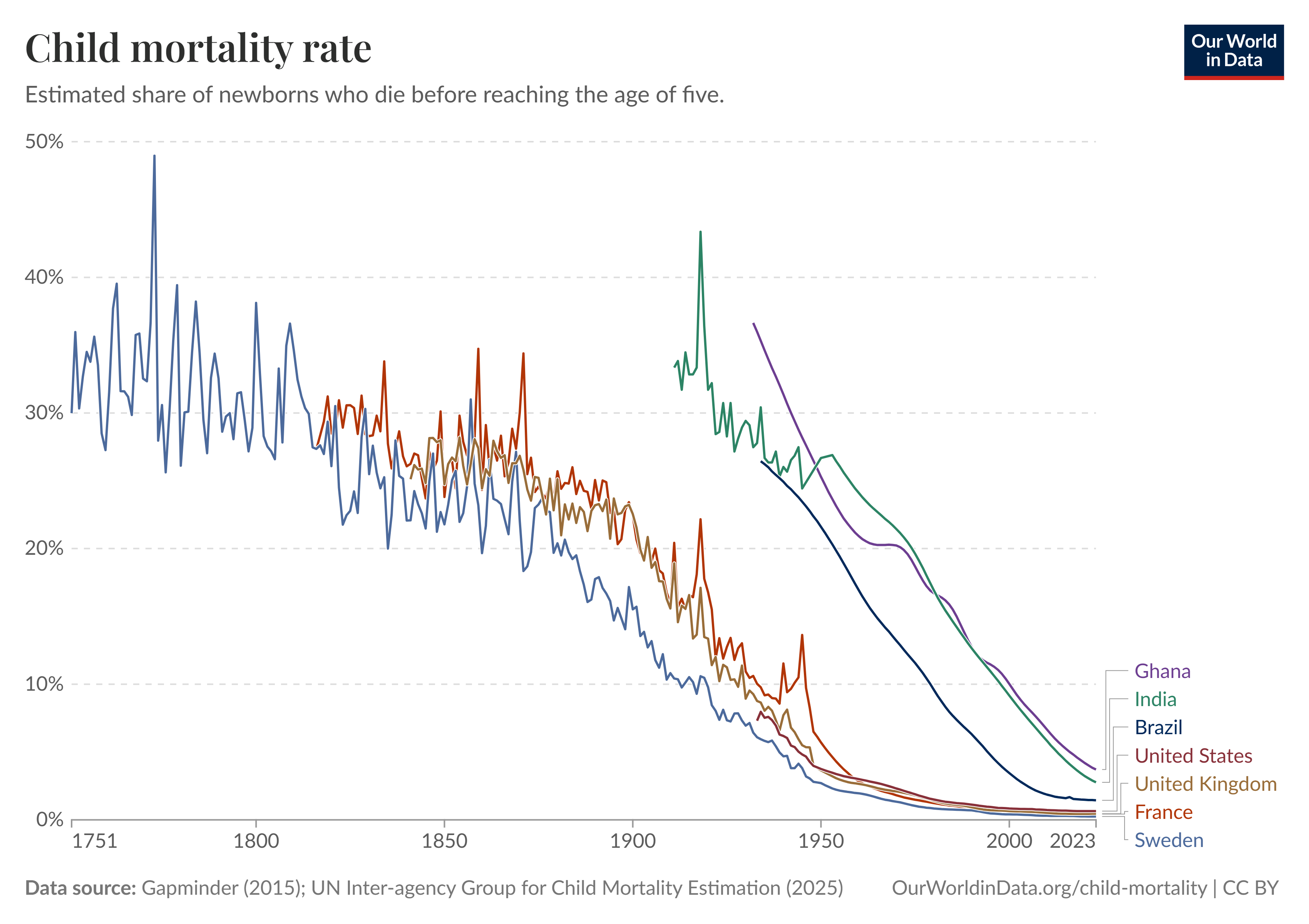
Before the development of modern medicine, children were much less likely to survive past childhood into their teen years. In the 1700s, this youth mortality rate averaged above 30%, only dropping below 20% into the 20th century. Further declining to present day, the proportion of infant death is much lower, nearly zero. However, these data are true for countries such as Sweden, France, and the United States. Other countries, including India and Ghana, took longer to decrease their youth mortality rate. Though great advances have been made, there is still room for improvement and collaboration between countries. Continuous advances in medicine will lower these rates even more, focusing on the development of healthy children.
|
|
|
|
Reposted from Our World in Data: Research and data to make progress against the world’s largest problems.
|
|
|
|
Data Science Updates is a collaborative effort of the Data Science Institute and Data Science Hub. This newsletter was originally created by the Data Science Hub and published as Hub Updates.
Use our submission form to send us your news, events, opportunities and data visualizations for future issues.
|
|
|
|
|