Data Science Updates is the University of Wisconsin-Madison's resource for news, training, events, and professional opportunities in data science, brought to you by the Data Science Institute, powered by American Family Insurance, and the Data Science Hub.
March 4, 2026
|
|
|
|
|
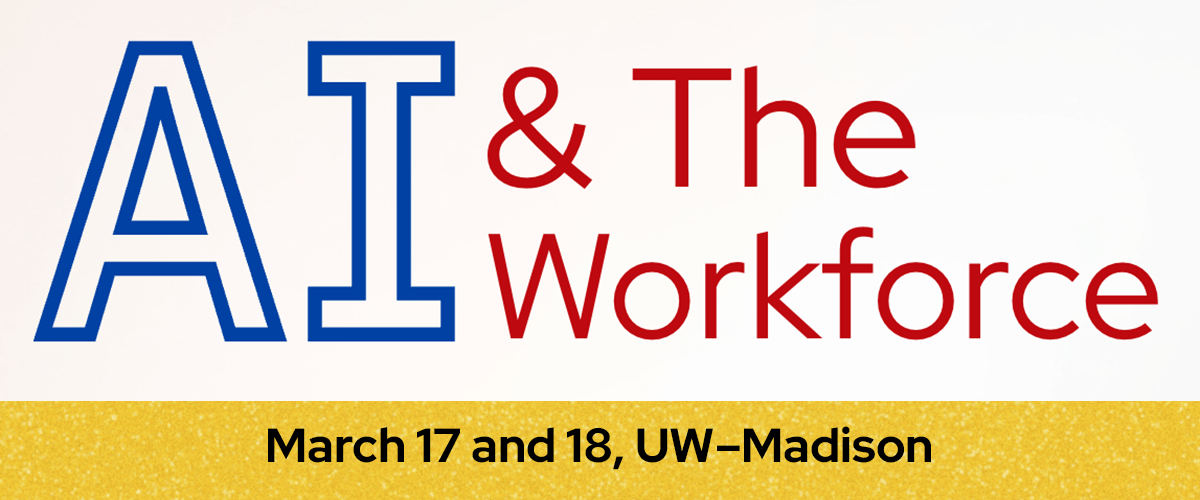
Join the Data Science Institute and the Digital Scholarship Hub on March 17 and 18 for a series of presentations addressing the impact of AI on the job market, careers, and mentoring students:
- Realities of the Labor Market: What the Data Tells Us. March 17, 2-3:15pm, Discovery Building— DeLuca Forum. Presenters will address some of the data-based realities of today’s labor market.
- Planning for Your Career in the Age of AI: A Panel Discussion. March 17, 4-5pm, Discovery Building—DeLuca Forum. Panelists from industry and campus will share their thoughts on staying competitive in today’s rapidly changing career landscape.
- Advising in the Age of AI: Mentoring Research and Gen AI Engagement for Career Preparedness. March 18, 2-4pm, Memorial Library—Digital Scholarship Hub. This workshop is for UW–Madison advisors and pre-registration is required.
|
|
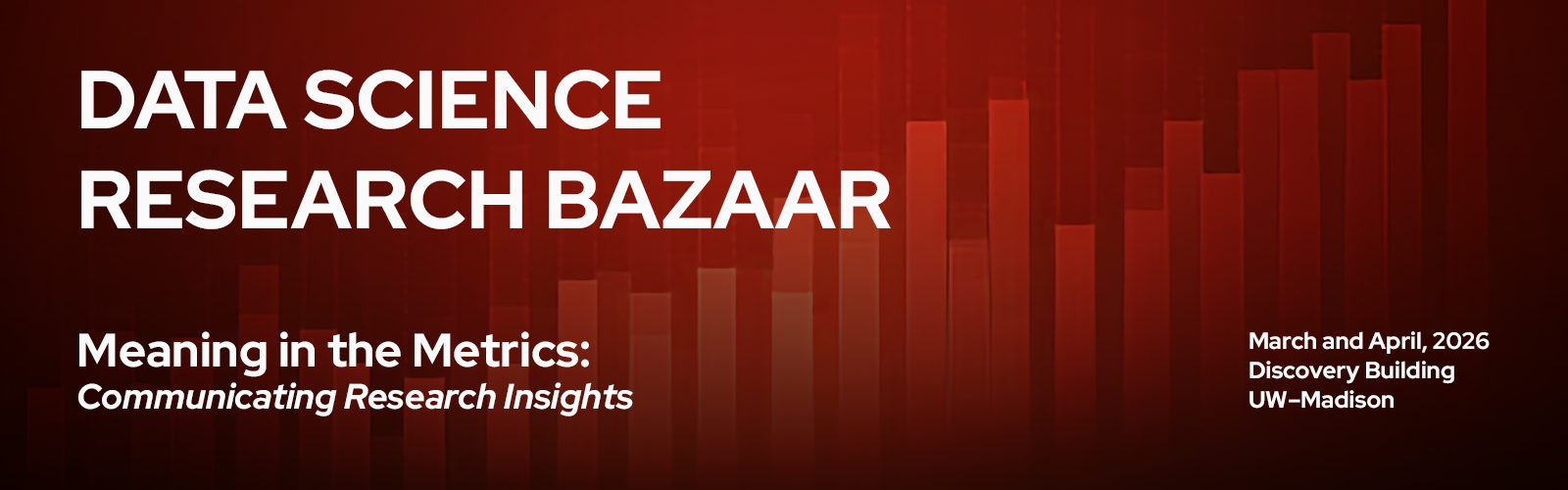
Whether you're a seasoned data scientist or just starting your journey, there's something for you at the Research Bazaar! This celebration of Meaning in the Metrics is an opportunity to learn, connect, and network with fellow data enthusiasts. Check out our lineup of speakers, lightning talks, and poster presenters for the Main Bazaar at the Discovery Building on March 19, and register by March 12 ( new deadline).
You can continue to engage and learn throughout this spring at Extended Bazaar trainings and focused discussions, including these events at the Discovery Building on March 23:
- Focused discussion: Applied data science for food access: Farm2Facts and Feast (9-10:30am)
- Training: Data for the People: Zines and DIY publishing for researchers (10:45am-12:15pm)
- Training: Better data science communication through improv (2-5pm)
Register by March 16 for these events. Visit our website for details about all of the Research Bazaar offerings this spring!
|
|
|
|
March 5, 9:00 a.m. - 1:00 p.m; Orchard View Room, Wisconsin Institute for Discovery. This workshop highlights Google Cloud services for managing infrastructure, machine learning, and generative AI. Presenters from Google and UW–Madison will provide details about how these and similar tools are being used and how you can get started using them. You will also learn about two UW–Madison initiatives designed to help reduce the cost of cloud computing.
|
March 5, 10:00 a.m. - 12:00 p.m; 224 Memorial Library. Data-driven narratives often fail to connect with broad audiences, limited by the abstract approaches that drive data visualization norms. This workshop will introduce practices from research into Data Theatre to reset how we can tell stories in and with publics. This collaborative showcase will highlight how embodied data storytelling can reclaim public space, foster solidarity, and make urgent issues resonate with audiences in powerful and accessible ways.
|
March 10, 12:00 p.m. - 1:00 p.m.; Discovery Building, Orchard View Room. In this month's forum, Dr. Joel Ferguson (Sustainable Land Systems, Nelson Institute) presents an applied ML pipeline that links historical aerial imagery to long-run economic outcomes.
|
March 11, 9:00 a.m. - 11:00 a.m.; 1145 Discovery Building. Machine Learning (ML) + Coffee is a monthly meetup for the UW community to discuss ongoing ML or artificial intelligence projects, share ideas, and find new tools and approaches. ML + Coffee offers a supportive, casual environment across a broad variety of departments. Coffee is provided to keep the ideas flowing.
|
March 25, 1:30 p.m. - 2:30 p.m; 3610 Morgridge Hall. Pytorch is a growing, popular software for machine-learning based workflows. This training is aimed towards researchers who have experience running Pytorch but need to scale up their workflow from their local computers to larger computing systems. A CHTC account is recommended. Visit the event page for more details.
|
|
|
|
Have questions about anything data science-related? Come see the Data Science Hub facilitators at Coding Meetup on Tuesdays and Thursdays from 2:30-4:30 p.m. CT. To join Coding Meetup, join data-science-hubgroup.slack.com.
|
|
|
|
March 4, 4:00 p.m. - 5:30 p.m.; 126 Memorial Library. Traditional data visualization techniques were not designed to foster participation or empowerment in community settings. Join Prof. Rahul Bhargava as he introduces creative arts-based approaches to working with data that go beyond the visual. Through case studies and examples, this talk explores how we can create more inclusive, engaging, and action-oriented interactions with information through multi-sensory invitations.
|
CGSI Genomic Seminar Series: Sushmita Roy
March 5, 1:30 p.m. - 2:30 p.m.; 1111 Genetics Biotechnology Center. Join the Center for Genomic Science Innovation (CGSI) in welcoming Sushmita Roy from the University of Wisconsin's Department of Biostatistics and Medical Informatics for her seminar titled Computational tools to examine dynamics of 3D genome organization and long-range gene regulation within and across species.
|
March 6, 12:00 p.m. - 1:00 p.m.; 140 Science Hall. Join Dr. Xiao Huang from Emory University for his talk titled "A new era of spatial intelligence with GeoAI." Through real-world case studies, including advanced computer vision integrated with urban visual analytics, GeoAI-enabled malaria intervention in East Africa, and Generative AI-supported geography education, the presentation illustrates how high-resolution satellite imagery, street-view data, foundation models, and community-engaged frameworks can transform geospatial information into actionable spatial intelligence.
|
Apply by March 20, UW-Madison. We are seeking applicants for the 2026 Open Source Grid (OSG) School, to be held July 13-17. Apply now and learn to harness large-scale computing for research. The OSG School teaches you how to use high-throughput computing effectively and get a research workload up and running. Past participants have come from physics, chemistry, engineering, math, bio and life sciences, earth sciences, agricultural and animal sciences, social sciences, economics, medicine, and more. Learn more and apply at the OSG School website.
|
April 1, 9:00 a.m. - 1:00 p.m.; Wisconsin Institute for Discovery. Join the Data Science Hub for their pilot workshop Building Better Research Software in R. We will be teaching next steps for doing software development as a researcher, after learning R, the Unix shell, and git/GitHub. This workshop includes how to create a project, use a reproducible environment, test your software, work with collaborators, write documentation, and more!
|
|
|
|
- Postdoctoral Research Associate, UW-Madison (Tiwari & Zhou)
- Postdoctoral Associate, University of Maryland Quantitative Biology Initiative
- Research Scientist / Software Developer, Norwegian Center for Molecular Biosciences and Medicine
- Domain Engineer, Elutions, Inc.
- AI Engineer, Elutions, Inc.
- Research Cyberinfrastructure Manager, UW-Madison DoIT
- Faculty Position in Computer Science: Artificial Intelligence and Machine Learning, UC-Irvine Department of Computer Science
- Industry Liaison, Wisconsin Health Data Hub
- Professor of Statistics, UW-Madison RISE-AI
- Dean, UW-Madison College of Computing and Artificial Intelligence
|
|
|
|
|
|
|
DATA VISUALIZATION OF THE WEEK
|
|
|
|
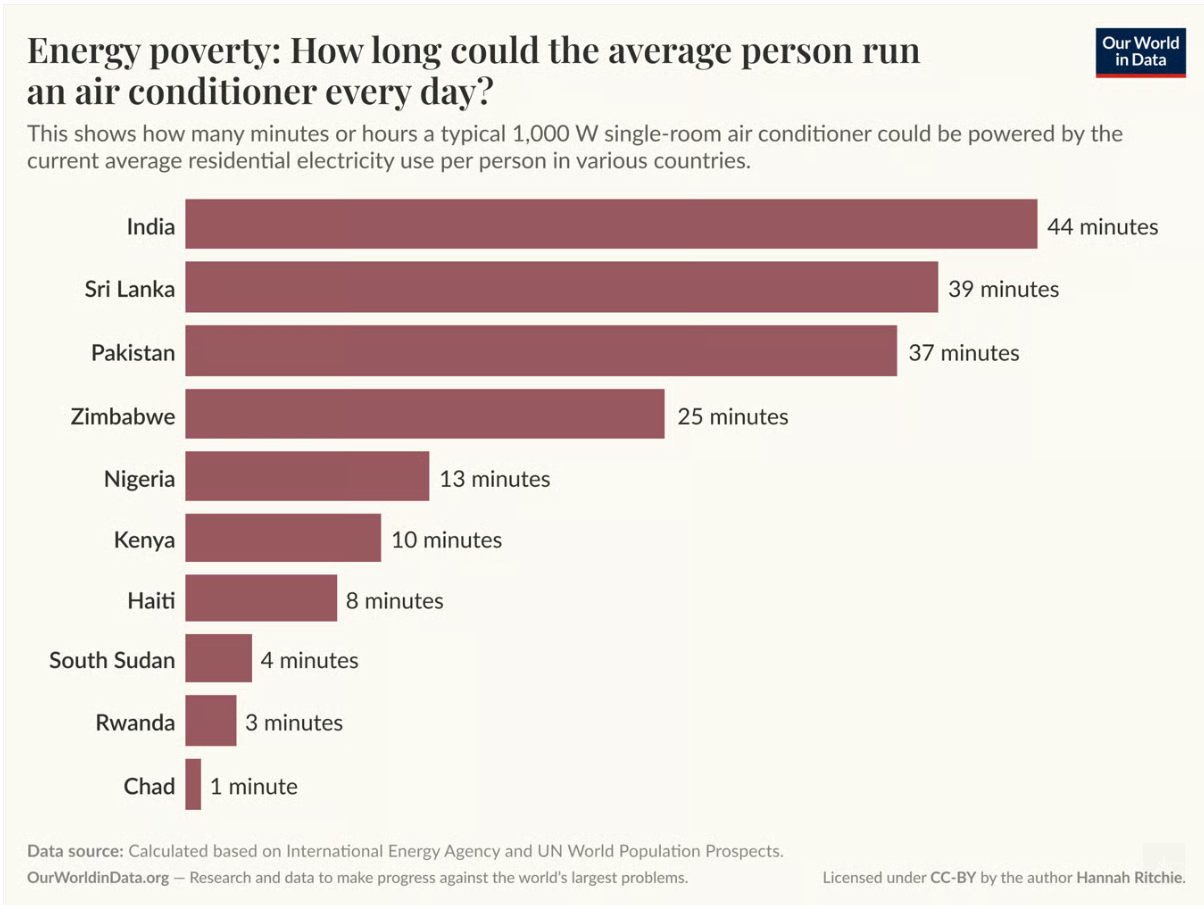
In the United States, air conditioning is often taken as a standard in modern buildings. Outside of the United States, AC use is more varied, as well as overall electricity usage. Per hour, a standard AC unit uses 1,000 watt-hours of electricity. In over 45 countries, however, the amount of daily electricity use per person is less than this value. The data visualization below shows a few sample countries and how many minutes a standard air conditioner could be powered with a person's full day of electricity use. This puts into perspective the global reality compared to the US's standard of electricity and air conditioning.
|
|
|
|
Reposted from Our World in Data: Research and data to make progress against the world’s largest problems.
|
|
|
|
Data Science Updates is a collaborative effort of the Data Science Institute and Data Science Hub. This newsletter was originally created by the Data Science Hub and published as Hub Updates.
Use our submission form to send us your news, events, opportunities and data visualizations for future issues.
|
|
|
|
|