Data Science Updates is the University of Wisconsin-Madison's resource for news, training, events, and professional opportunities in data science, brought to you by the Data Science Institute, powered by American Family Insurance, and the Data Science Hub.
April 29, 2026
|
|
|
|

|
|
|
|
The UW Research Software Engineer (RSE) community is launching a resource sharing platform, the UW RSE Nexus. Join us on Tuesday, May 5 from 10-11 a.m. in room 1145 of the Discovery Building for a presentation highlighting the soft launch, open discussion, and request for collaboration on this open source project.
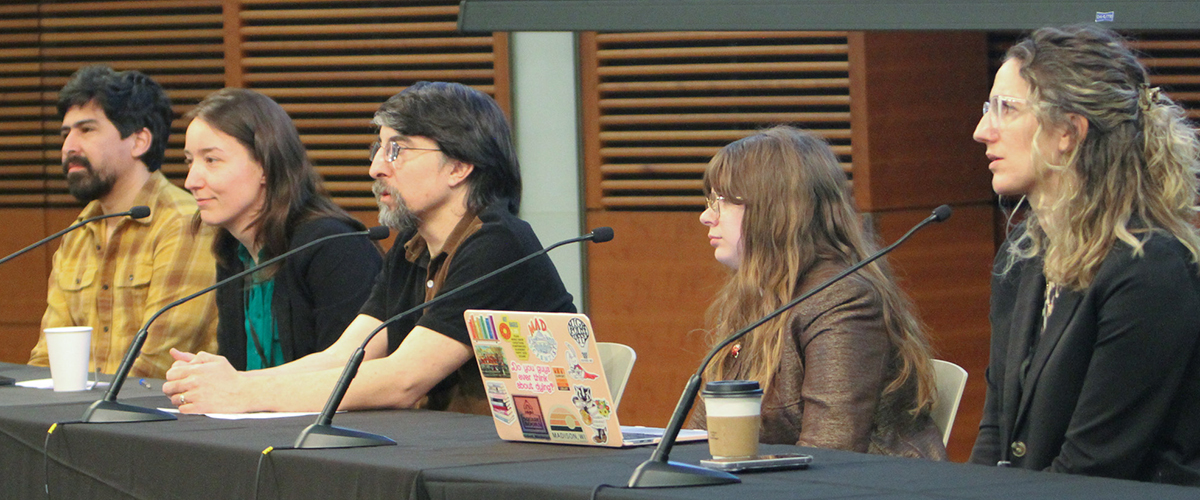
If you develop scripts or software as part of your research or are interested in improving research by integrating, managing, and improving software, the UW RSE community is the place for you. Become part of the community by joining the email group and attending the monthly storytelling sessions. Find out more at the UW RSE Community website.
|
|
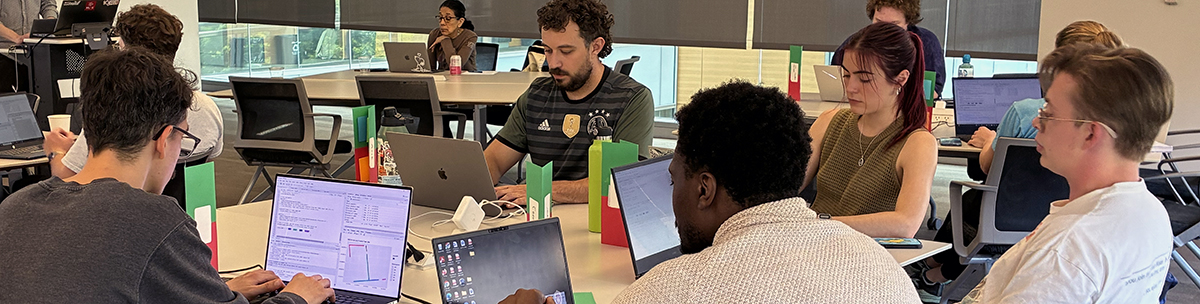
The 2026 Data Science Research Bazaar brought together people from across campus and the community to discuss finding Meaning in the Metrics by translating and communicating data. 191 registered participants joined us for the main Research Bazaar on March 17, along with workshops and discussions throughout the spring. This annual event is hosted by the Data Science Hub and a planning committee representing departments and programs across campus. Video recordings of selected sessions will be available soon. Thank you to everyone who contributed to the success of this year’s event!
|
WISCURDS, the Data Science Institute's faculty-mentored undergraduate research program, simplifies the process of engaging bright, motivated students in data-driven work. This research opportunity pairs faculty with highly qualified undergraduates who have enthusiastically raised their hands to volunteer with research efforts. When you submit a project idea to WISCURDS, you will gain access to motivated undergraduates with strong quantitative and computational backgrounds. Project proposals are accepted on a rolling basis. To submit a project or learn more, visit our website or email wiscurds@datascience.wisc.edu.
|
|
|
|
May 6, 9:00 - 11:00 a.m.; 1145 Discovery Building. Machine Learning (ML) + Coffee is a monthly meetup for the UW community to discuss ongoing ML or artificial intelligence projects, share ideas, and find new tools and approaches. ML + Coffee offers a supportive, casual environment across a broad variety of departments. Coffee is provided to keep the ideas flowing.
|
May 14, 1:00 - 3:00 p.m; Wisconsin Institutes for Medical Research, 1022. Jameson Merkow and Ivan Tarapov from Microsoft will visit the Department of Radiology to host a hands-on seminar focused on the practical application of foundation models in medical imaging. This hands-on learning lab will focus on technical execution, efficient adaptation, and system-level integration. Space may be limited. Please RSVP here.
|
May 26-29; Morgridge Hall. The Digital Investigations Bootcamp is the first intensive, hands-on OSINT training program in the Midwest designed specifically for data scientists, journalists, OSINT practitioners, and researchers. Hosted by the Public Tech Media Lab, participants will acquire immediately applicable skills in chronolocation and geolocation, advanced search techniques, social media analysis and verification, safety and security practices, and ethical protocols. All sessions will take place at the WARF Centennial Seminar Hub at Morgridge Hall in Madison. Register soon at the Digital Investigations Bootcamp website.
|
|
|
|
Have questions about anything data science-related? Come see the Data Science Hub facilitators at Coding Meetup on Tuesdays and Thursdays from 2:30-4:30 p.m. CT. To join Coding Meetup, join data-science-hubgroup.slack.com.
|
|
|
|
April 29, 12:30 p.m.; Orchard View Room, Wisconsin Institute for Discovery, and Zoom. This seminar welcomes Ben Recht, Professor in the Department of Electrical Engineering and Computer Sciences at the University of California–Berkeley, for his talk titled The Irrational Decision: How We Gave Computers the Power to Choose for Us. Join the SILO email list to RSVP for the in-person seminar or use the Zoom link.
|
April 29, 12:00 - 1:30pm; Memorial Library 224. It's easy to think of data as something that lives in spreadsheets, but it rarely starts—or ends—there. Join the Digital Scholarship Hub for a moderated conversation about the physical, material aspect of working with data. They have invited an interdisciplinary group to discuss the impact of the physical world on their research: digitizing thousand-year-old manuscripts, building knowledge graphs for regional food systems, studying how scientific visuals move public opinion, and uncovering the information embedded in everyday objects. Refreshments will be provided.
|
May 7, 1:30 p.m. - 2:30 p.m.; 1111 Genetics Biotechnology Center. Join the Center for Genomic Science Innovation (CGSI) in welcoming Anna Selmecki from the University of Minnesota for their seminar talk titled The Candida albicans Pangenome: Insights into Evolution and Pathogenicity.
|
May 11, 11:00 a.m.; Zoom. Join this seminar on AI for accelerating medical discovery with Dr. Hoifung Poon, general manager of Real-World Evidence at Microsoft Research, for his talk about the intersection of AI and patient treatment.
|
May 14, 9:30 a.m.; Biochemical Sciences Building 1211. Shaun Mahony, Associate Professor of Biochemistry and Molecular Biology at Penn State University, will give a special seminar jointly hosted by the BMC and BMI departments. His research develops deep-learning models to understand how transcription factors bind selective regions of the genome, and he tests these models in the laboratory.
|
May 28, 3:00 p.m. reception, Health Sciences Learning Center Atrium; 4:00 p.m. lecture, HSLC 1325. This lecture welcomes Professor Aaron Y. Lee, Washington University. His talk will review key fundamentals in deep learning and computer vision, highlighting recent advances and the rapidly changing AI landscape in medicine. It will explore the rise of large language models and their growing impact on clinical care, research, and healthcare workflows.
|
June 1, 2026; Green Bay. UWEBC is bringing together technology, data, and digital leaders at Lambeau Field for a reimagined Digital Symposium, co-located with the Wisconsin Drives Manufacturing Summit. This year’s Digital Symposium focuses on how organizations are operationalizing digital capabilities to drive measurable outcomes across the ecosystem. Attendees can expect practical insights, peer-driven conversations, and examples grounded in real organizational challenges. Non-UWEBC members can use the discount code “DSI” to save $50 when registering.
|
June 9-12; UW-Madison and via Zoom. HTC26 brings together researchers, campuses, science collaborations, facilitators, administrators, government representatives, and professionals interested in high throughput computing. Session and talk topics include vibe-coding the future, AI driven research and user challenges, using AI tools to understand and debug HTCondor and Pelican, and more. The deadline for in-person registration is May 31.
|
|
|
September-December, 2026. Each fall, 100+ applied ML/AI practitioners across UW–Madison spend a semester working through a curated set of challenges sourced from campus researchers and beyond. Participants are supported throughout with hands-on cloud workshops, compute credits, ML/AI and domain-expert advisors, and our community-maintained resource hub for ML/AI work at UW–Madison. Fill out the interest form by June 1.
|
January 8-15, 2027. The International Statistical Ecology Conference will take place in Merida, Mexico. If you would like to be included in the program, please submit an abstract for consideration. At the conference there will be talks, posters, and workshops focused on statistical applications, software development, machine learning, and AI, motivated by a range of applications and data structures in ecology. The deadline for abstract submission is May 1, 2026.
|
|
|
|
|
|
|
DATA VISUALIZATION OF THE WEEK
|
|
|
|
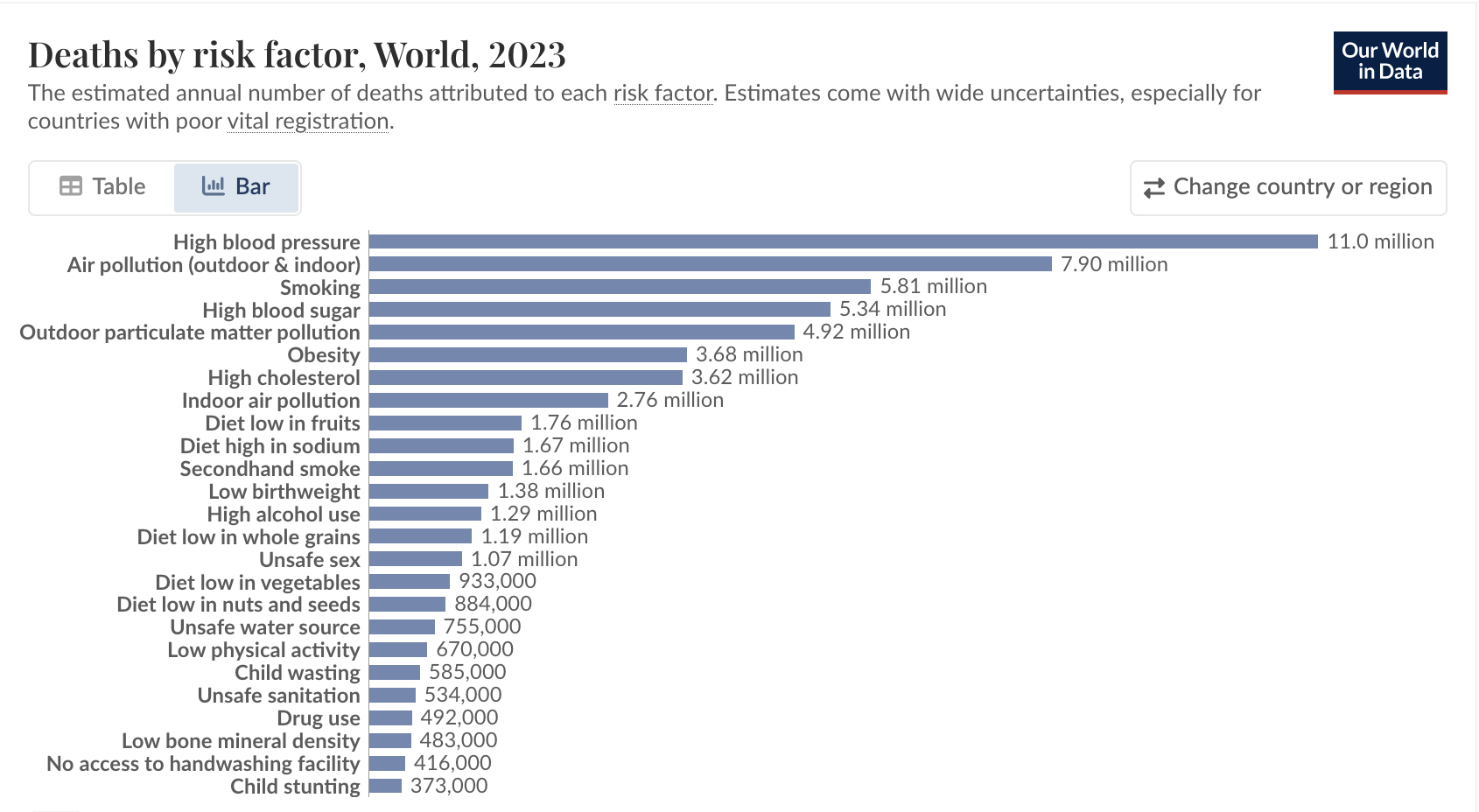
Air pollution poses a significant threat to human health and the environment. This graph, which includes some of the world's leading risk factors for death, shows us that air pollution is one of the top factors globally, exceeded only by high blood pressure. There are many other factors that contribute to death risk including smoking, high blood sugar, outdoor particulate matter pollution, obesity, high cholesterol, diet, secondhand smoke, and more.
|
|
|
|
Reposted from Our World in Data: Research and data to make progress against the world’s largest problems.
|
|
|
|
Data Science Updates is a collaborative effort of the Data Science Institute and Data Science Hub. This newsletter was originally created by the Data Science Hub and published as Hub Updates.
Use our submission form to send us your news, events, opportunities and data visualizations for future issues.
|
|
|
|
|