Data Science Updates is the University of Wisconsin-Madison's resource for news, training, events, and professional opportunities in data science, brought to you by the Data Science Institute, powered by American Family Insurance, and the Data Science Hub.
May 13, 2026
|
|
|
|
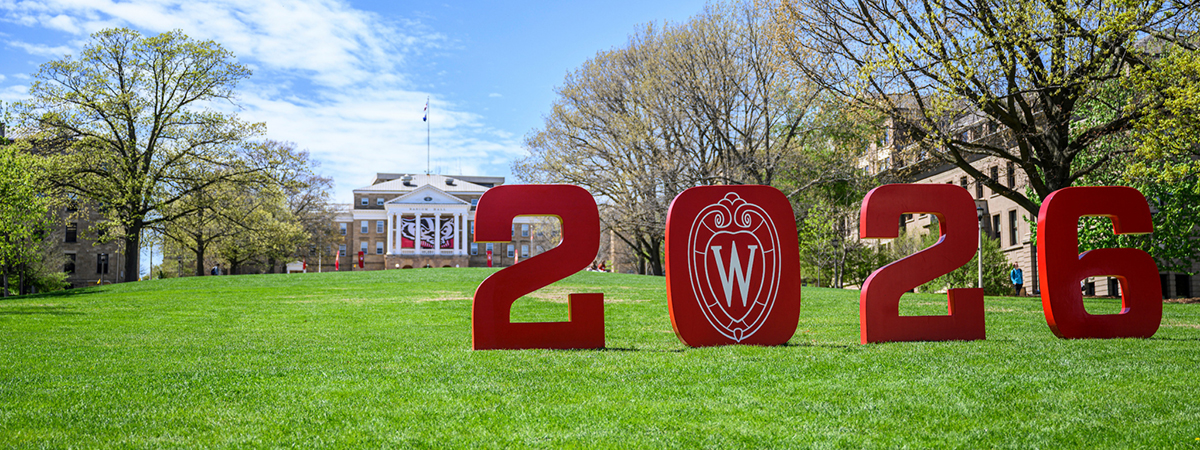
Hundreds of new alumni of the School of Computer, Data, & Information Sciences celebrated graduation this weekend. Congratulations and best wishes to these data science, statistics, computer science, and information science graduates! Read on to learn more about a few of the CDIS grads who have made significant contributions on and off campus.
|
|
|
|
How can you automate working with geospatial data in R? Join us for Geospatial Data Carpentry in the Discovery Building, June 1-4 from 1-4:30pm to add this skill to your toolbox. This workshop is designed for participants with basic R experience who want to work with geospatial data. It begins with an introduction to key geospatial concepts and continues with hands-on practice using both raster and vector data in R. Registration is required. Please see the workshop website for more information and to register.
|
Undergraduates: Level Up Your Research Skills This Summer
This June, the Data Science Hub will be hosting two free workshops exclusively for UW–Madison undergrads and students affiliated with summer research programs. Data Carpentry, running June 1-4, will focus on organizing and presenting data using tools such as spreadsheets, OpenRefine, SQL, and R. Learn more and register here. L ater in the month, Software Carpentry (June 15-18) offers an introduction to computer coding for research, including Unix, Git, and Python; register here. These workshops are highly recommended for students involved in summer research projects, or who are hoping to get involved in a lab this fall.
|
Summer Publication Schedule
Following this newsletter, Data Science Updates will move to a monthly schedule for summer publication. The newsletter will return to its biweekly format in the fall. Please be aware of this schedule adjustment when submitting your content to Data Science Updates.
|
|
CAMPUS WORKSHOPS
|
May 14, 1-3 p.m.; Wisconsin Institutes for Medical Research 1022. Jameson Merkow and Ivan Tarapov from Microsoft will visit the Department of Radiology to host a hands-on seminar focused on the practical application of foundation models in medical imaging. This hands-on learning lab will focus on technical execution, efficient adaptation, and system-level integration. Space may be limited. Please RSVP here.
|
May 26-29; Morgridge Hall. The Digital Investigations Bootcamp is the first intensive, hands-on OSINT training program in the Midwest designed specifically for data scientists, journalists, OSINT practitioners, and researchers. Hosted by the Public Tech Media Lab, participants will acquire immediately applicable skills in chronolocation and geolocation, advanced search techniques, social media analysis and verification, safety and security practices, and ethical protocols. All sessions will take place at the WARF Centennial Seminar Hub at Morgridge Hall in Madison. Register soon at the Digital Investigations Bootcamp website.
|
June 17, 2-4 p.m.; 1145 Discovery Building. Sci-Prov workshops are designed for graduate students, post-docs, staff, and faculty in STEM-related fields who want to sharpen their ability to communicate effectively. These free sessions provide a lively, low-stakes space to build confidence in handling the unexpected and the ability to pivot one’s communication. This Message Crafting workshop focuses on refining and delivering messages without jargon, varying timelengths, enhancing stories with emotion, and pivoting when needed. Space is limited; register today to secure your spot!
|
|
|
|
Have questions about anything data science-related? Come see the Data Science Hub facilitators at Coding Meetup on Tuesdays and Thursdays from 2:30-4:30 p.m. CT. To join Coding Meetup, join data-science-hubgroup.slack.com.
|
|
|
|
May 13, 12:30-1:30 p.m.; Orchard View Room, Wisconsin Institute for Discovery, and Zoom. This seminar welcomes Ludwig Schmidt, assistant professor at Stanford University and a member of the technical staff at Anthropic, for his talk titled Data for training and evaluating agents: OpenThoughts and Terminal-Bench. Held in a hybrid format, participants are welcome to attend either in-person or via Zoom.
|
May 14, 9:30 a.m.; Biochemical Sciences Building 1211. Shaun Mahony, associate professor of biochemistry and molecular biology at Penn State University, will give a special seminar jointly hosted by the BMC and BMI departments. His research develops deep-learning models to understand how transcription factors bind selective regions of the genome, and he tests these models in the laboratory.
|
May 15, 12-1 p.m.; 140 Science Hall. This seminar welcomes Dr. Yun Hang, assistant professor at the University of Texas Health Science Center, for her talk titled From Space to Health: Satellites and AI for Environmental Exposure Assessment. This talk will introduce a spatial data science approach that integrates satellite data with classical machine learning models to assess environmental exposures from local community to global scales.
|
May 22, 10-11:15 a.m.; Orchard View Room 3280 and Zoom. Join WID for its final seminar series presentation on Visual Science Communication in the Age of AI with Nan Li, WID Discovery Fellow and associate professor of life sciences communication. Held in a hybrid format, participants are welcome to attend either in-person or via Zoom.
|
May 28, 3 p.m. reception, Health Sciences Learning Center (HSLC) Atrium; 4 p.m. lecture, HSLC 1325.
This lecture welcomes Professor Aaron Y. Lee, Washington University. His talk will review key fundamentals in deep learning and computer vision, highlighting recent advances and the rapidly changing AI landscape in medicine. The lecture will explore the rise of large language models and their growing impact on clinical care, research, and healthcare workflows.
|
June 1, 2026; Green Bay. UWEBC is bringing together technology, data, and digital leaders at Lambeau Field for a reimagined Digital Symposium, co-located with the Wisconsin Drives Manufacturing Summit. This year’s Digital Symposium focuses on how organizations are operationalizing digital capabilities to drive measurable outcomes across the ecosystem. Attendees can expect practical insights, peer-driven conversations, and examples grounded in real organizational challenges. Non-UWEBC members can use the discount code “DSI” to save $50 when registering.
|
June 9-12; UW-Madison and via Zoom. HTC26 brings together researchers, campuses, science collaborations, facilitators, administrators, government representatives, and professionals interested in high throughput computing. Session and talk topics include vibe-coding the future, AI driven research and user challenges, using AI tools to understand and debug HTCondor and Pelican, and more. The deadline for in-person registration is May 31.
|
|
|
July 13, 11 a.m.; Zoom. Join this seminar on AI for accelerating medical discovery with Dr. Hoifung Poon, general manager of Real-World Evidence at Microsoft Research, who will talk about the intersection of AI and patient treatment.
|
September-December, 2026. Each fall, 100+ applied ML/AI practitioners across UW–Madison spend a semester working through a curated set of challenges sourced from campus researchers and beyond. Participants are supported throughout with hands-on cloud workshops, compute credits, ML/AI and domain-expert advisors, and our community-maintained resource hub for ML/AI work at UW–Madison. Fill out the interest form by June 1.
|
|
|
|
|
|
|
DATA VISUALIZATION OF THE WEEK
|
|
|
|
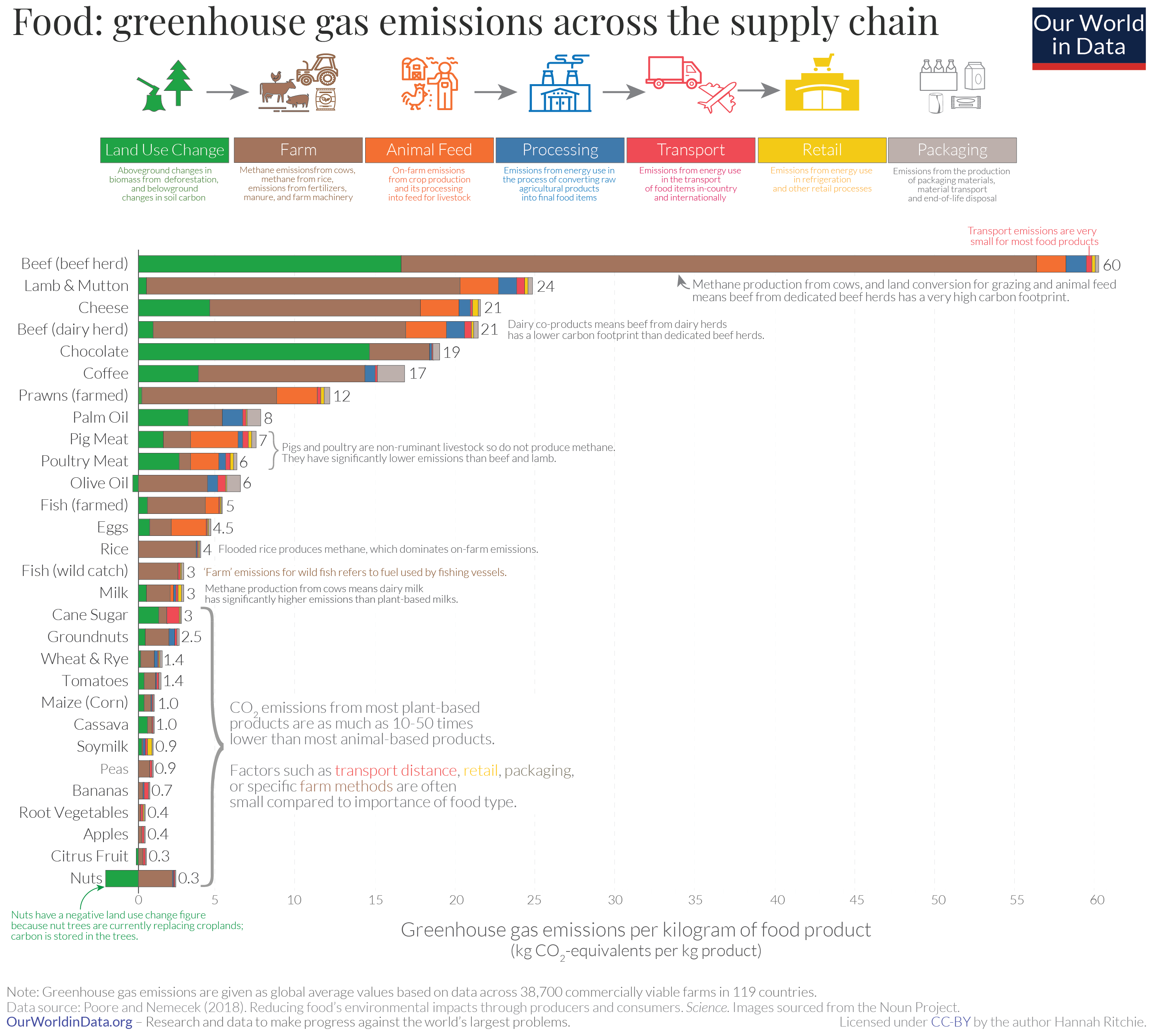
The graphic below displays greenhouse gas (GHG) emissions for twenty-nine food products across various stages of the supply chain. Findings show supply chain steps commonly blamed for negative environmental impacts – processing, transport, retail, and packaging – actually account for only a small share of overall GHG emissions. Rather, eating local to minimize these functions only slightly reduces your carbon footprint of food. While still beneficial for decreasing GHG emissions, what you consume on a regular basis was determined to be more important. View the interactive graphic for more details!
|
|
|
|
Reposted from Our World in Data: Research and data to make progress against the world’s largest problems.
|
|
|
|
Data Science Updates is a collaborative effort of the Data Science Institute and Data Science Hub. This newsletter was originally created by the Data Science Hub and published as Hub Updates.
Use our submission form to send us your news, events, opportunities and data visualizations for future issues.
|
|
|
|
|