Data Science Updates is the University of Wisconsin-Madison's resource for news, training, events, and professional opportunities in data science, brought to you by the Data Science Institute, powered by American Family Insurance.
August 12, 2026
|
|
|
|
|
|
The Open Source Program Office (OSPO) is looking to connect students with meaningful open source projects through its internship program. OSPO facilitates recruitment, matching, and hiring and supports interns with an onboarding session, weekly check-ins, and professional development. Mentors support and direct internship activities, providing feedback and skill development. This is a fantastic opportunity for UW–Madison faculty and teaching staff to receive project support while offering interns practical experience and the chance to contribute to impactful work. Submit your proposal for the spring 2027 intern cohort by 8/21.
|
The Machine Learning Marathon (MLM26) brings together teams from across campus to work on diverse ML/AI projects (challenges) during the fall semester. UW–Madison students, postdocs, faculty, and staff can participate in this hackathon, led by the ML+X community. The challenges cover a wide span of methods and skill levels. Most are approachable if you have Python, ML, and GitHub. We encourage you to come to the Challenge Showcase on August 19, 4:00-5:30pm CT on Zoom. Applications open at the end of this showcase. Visit the MLM26 website and FAQ to learn more.
|
|
AI’s Impact on the Creative World will be hosted by the Creative Futures Lab on September 29 at the Pyle Center. This conference will bring together thought leaders at UW–Madison and from across the country who are curious to understand the impacts of AI and eager to envision a future in which the creative media industry can thrive. This event is open to anyone interested in shaping the future of creative media. Use the discount code MWMEDIA26 to receive $50 off when you register.
|
The Igniting Interdisciplinary Innovation (I³) initiative was launched last fall to bring together researchers from across disciplines and develop transformative research ideas aligned with, or complementary to, UW–Madison’s RISE focus areas in AI, sustainability, and health. I³ drew hundreds of researchers who formed interdisciplinary teams through a series of incubation sessions. Ultimately, 17 teams were selected to receive one-year seed awards. I 3 is led by the Office of the Vice Chancellor for Research with support from the Wisconsin Alumni Research Foundation.
|
|
CAMPUS WORKSHOPS
|
August 17, 12-4 p.m.; 4218 Sewell Social Sciences. Stata is a powerful (and relatively easy to learn) statistical analysis software. This introductory course is designed for students who need to use Stata in their classes, but aren't partaking in active research yet or anticipate doing much quantitative research in the future. Registration is required to attend. Register now.
|
September 23, 2026 | 8:30 a.m.–1 p.m. Tripp Commons, Memorial Union. Interested in the intersection of water and data centers? Join Water@UW–Madison for a collaborative workshop bringing together researchers, practitioners, and students to explore emerging challenges and opportunities related to water use, environmental impacts, data center design, policy, and knowledge production within the current public debates. This event is free to attend, but registration is required. Register now.
|
|
|
|
Have questions about anything data science-related? Come see the Data Science Facilitation Team at Coding Meetup on Tuesdays and Thursdays from 2:30-4:30 p.m. CT. To join Coding Meetup, join data-science-hubgroup.slack.com.
|
|
|
|
August 18, 10 a.m.; Zoom. Join Kris Sankaran, PhD, assistant professor in the Department of Statistics at UW–Madison and a discovery fellow at the Wisconsin Institute for Discovery, for this seminar on New Diagnostics for Dimensionality Reduction. This seminar will address two risks in dimensionality reduction.
|
August 18, 12-1:30 p.m.; Online. The Center for Teaching, Learning & Mentoring is hosting a zoom session on AI topics in teaching. This session features Pajarita Charles, Ph.D, associate professor at the Sandra Rosenbaum School of Social Work. Discussion topics will include AI expectations for syllabi, assignments and assessments, and exploring responses if you believe AI may have been used inappropriately. Registration is required. Register now.
|
Monthly on Wednesdays (9/9, 10/7, 11/11 & 12/9), 9-11 a.m.; Discovery Building (Room 1145). ML+Coffee offers the perfect opportunity to discuss ongoing ML/AI projects and share knowledge across campus. Join the group monthly on Wednesdays for coffee, pastries, and ML/AI conversation. Whether you're looking for advice on applying ML/AI to your data, hoping to demo a tool or method, or are interested in discussing a paper, ML+Coffee provides a supportive environment for doing so.
|
Thursday, September 3, 1-2:30 p.m.; Discovery Building (Deluca Forum). Join Gene Yeo, visiting scientist and entrepreneur, for an interesting conversation on his work and journey from RNA biology and therapeutics to the creation of multiple RNA-focused startups, including aMBR genomics (which is located here, in Madison). Discussion will also include his career path, background, and insight surrounding how faculty, trainees, and staff can translate deep science into companies without abandoning their academic identity. Registration is required.
|
September 27 - October 2; Discovery Building. BINA’s 2026 Community Congress will be held jointly with Images 2 Knowledge (I2K). I2K brings together developers, researchers, and students from around the world working in computational image analysis. Over the years, the I2K Conference has become a flagship event for scientists eager to explore interactive tutorials and cutting-edge, open-source solutions for biological image reconstruction and analysis. Register now.
|
|
|
|
|
|
|
DATA VISUALIZATION OF THE WEEK
|
|
|
|
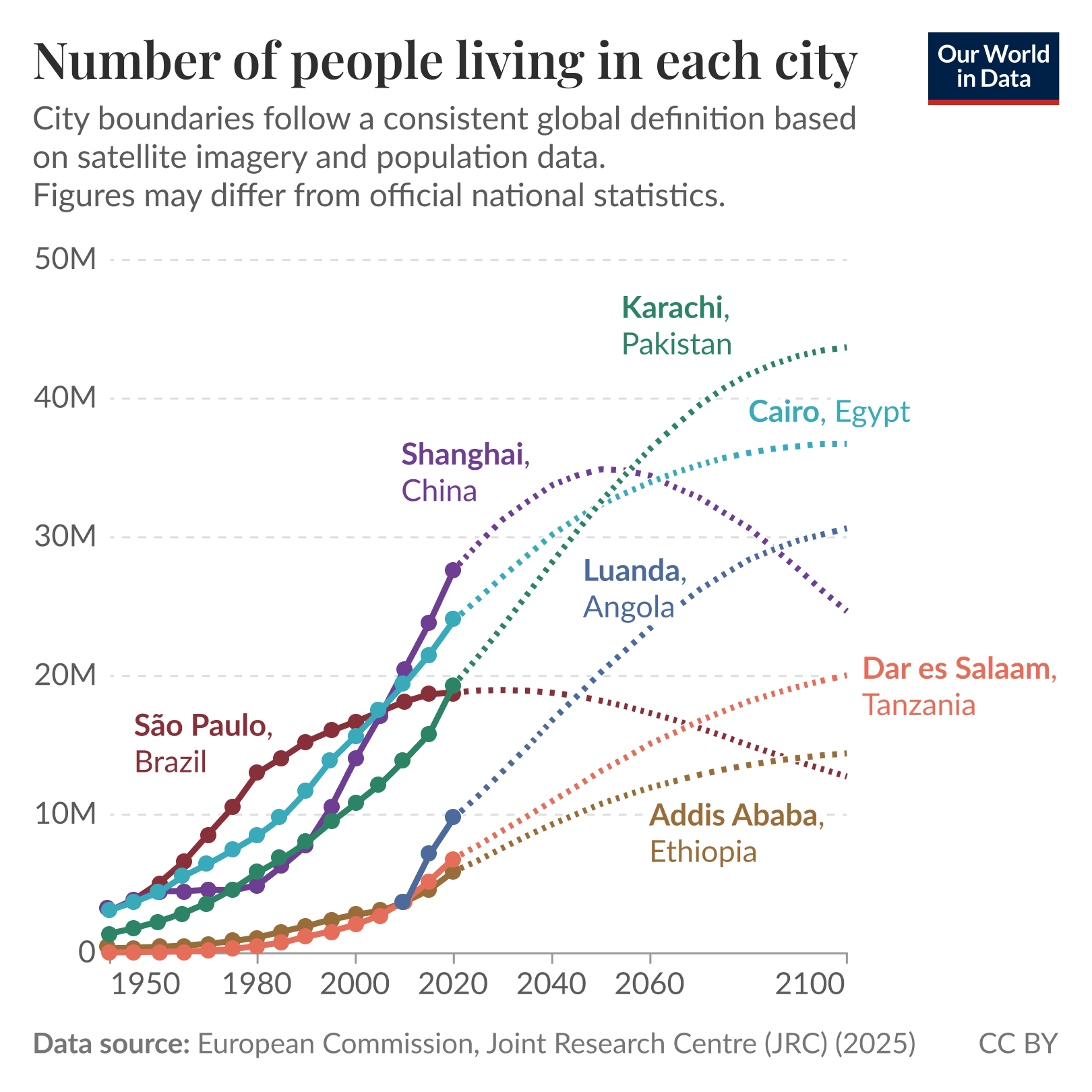
For the past few decades, cities across East Asia and Latin America have experienced rapid population growth, but that trend is now beginning to shift. São Paulo is nearing its population peak, while Shanghai is expected to peak around 2050. As the chart shows, some of the fastest-growing megacities are now emerging in Africa and South Asia, including Karachi, Dar es Salaam, Addis Ababa, and Luanda. Luanda is especially interesting, as it is projected to overtake São Paulo in population within about 20 years. This shift is important because it highlights where much of the world’s future urban growth may take place, creating new challenges and opportunities for infrastructure, housing, jobs, and investment. Check out more here!
|
|
|
|
Reposted from Our World in Data: Research and data to make progress against the world’s largest problems.
|
|
|
|
Data Science Updates is a publication of the UW–Madison Data Science Institute.
Use our submission form to send us your news, events, opportunities and data visualizations for future issues.
|
|
|
|
|