|
|
Greetings from HAQAST
Dear HAQAST Community,
|
|
|
|
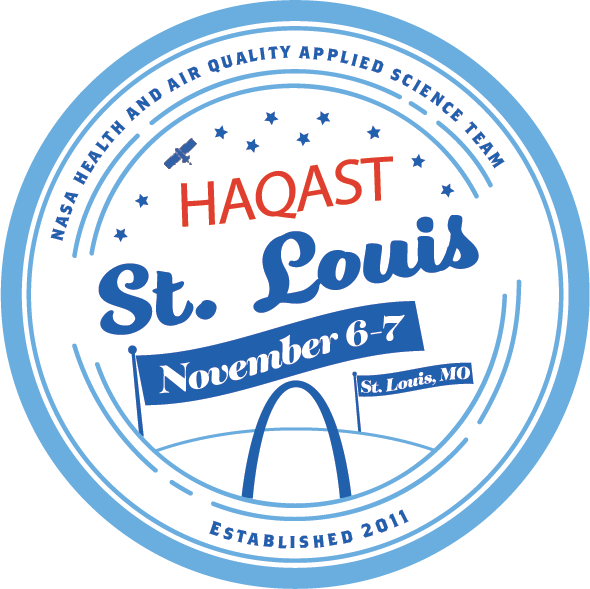
We are looking forward to seeing many of you in St. Louis and online for the upcoming hybrid HAQAST meeting November 6-7. This public meeting offers an opportunity to meet our new team members and learn about new applied research directions of this 2025-2029 HAQAST team. As always, we design our meetings to grow connections between stakeholders and scientists in the air quality, public health and satellite data communities, build two-way dialogue on ideas and initiatives, share new data and tools, and build professional networks We hope to see you there!
Registration is free, and you can register here.
|
|
|
|
|
|
HAQAST News
- HAQAST Ambassador Pallavi Pant interviewed HAQAST Team lead Tracey Holloway about satellite data and air quality on the Health Effects Institute's Science on the 7th stream. Listen to the recording here. Tracey was also recently elected as an American Geophysical Union Fellow!
- Laura Judd spoke on Faces of Technology about air quality field studies. Check it out here!
You can find all of the latest HAQAST publications here! Recent highlights include articles a review on satellite data for air quality management, ozone, health impacts of smoke, including the papers below:
|
|
|
NASA News
Federal Shutdown - NASA, along with the rest of the federal government has been shutdown pending approval of a new budget and/or continuing resolution by Congress. Data currently being collected can be found via NASA’s EarthData Search. Users should anticipate, however, increased risk for data outages and delays due to reduced on-site support for the science data systems.
|
|
|
Upcoming Meetings and Events of Interest
- Ongoing, self-paced - ARSET Fundamentals of Remote Sensing.
- October 6 - 29: NOAASatHack: The NOAA Satellites Hackathon invites undergraduate and graduate college students to participate in this virtual event. The challenge is for students to develop a public awareness campaign about an environmental hazard by connecting NOAA satellite data to neighborhood level impacts. Learn more here.
- October 21: GEO Health Community of Practice / AfriGEO Special Edition flash talks. Those wishing to present 4-minute flash talks sharing current research activities using Earth observations for public health applications in the African region should apply by October 15. More information here.
- November 6 - 7: HAQAST St. Louis. Find more information here. This free, hybrid event brings together researchers and stakeholders in public health, air quality, and satellite data. Register here.
- November 12 & 19: NASA ARSET- Advanced NASA Earth Observations and Tools for Active Fire, Smoke, and Post-Fire Monitoring. This two-part training led by NASA's Applied Remote Sensing Training (ARSET) program will introduce participants to several capabilities within FIRMS that were not included in the previous ARSET training, Introduction to NASA Earth Observations and Tools for Wildfire Monitoring and Management. Participants will learn how to use the FIRMS aerosol index indices, burned area products, post-fire indices and imagery, static thermal anomaly information, and how to use Jupyter Notebooks to ingest and visualize active fire detection data. Learn more here.
- November 14: Dust Alliance of North America (DANA) webinar - Smoke, Dust, and Resilience: Unraveling the March 2025 Oklahoma Compound Hazards. 1:00 pm ET. More on DANA webinars and recordings of past webinars can be found here.
- November 19: CAFE RCC half-day event: Wildfires and Health: From Research to Resilience. Part of the Extreme Weather Half-Day Event Series. This event focuses on the intersection of wildfires and public health. Register here, and proposal a lightning talk here.
- December 15 - 19: American Geophysical Union (AGU25)
- January 20 - 23: ESIP meeting, online. The theme for 2026, "Bridging Divides: Data, Technology, Community," calls on the Earth Science Data community to continue to build more open data ecosystems, harmonize tools and resources, and strengthen the human connections that are the bedrock of great science. Submission deadline: November 13. More information here.
- January 25 - 29: American Meteorological Society (AMS) Annual Meeting 2026.
|
|
|
Internships and Jobs
If you are hiring, please feel free to share via email or LinkedIn – we’d love to help the community connect!
Job Boards
Here are a few of the jobs boards which often include opportunities relevant to the health, air quality and remote sensing communities.
Mentorship Opportunity
Interested in serving as a mentor? Health Effects Institute is seeking mentors at research institutions to apply to host an undergraduate student in the summer of 2026. Mentor applications are due October 24, 2025. Learn more here.
|
|
|
Funding Opportunities
The Taylor Geospatial Institution has a current challenge open: "Geospatial Innovation for Food Security," seeking proposals on novel approaches to enhancing food security and sustainable agriculture through advances in applications of geospatial technologies, methods and models, organized around several topic areas. Awards of up to $550K with a period of performance of 18 months are expected. TGI is also seeking reviewer applications. Proposal applications and applications for reviewers are due October 31st. Learn more here.
NASA has released the Research Opportunities in Space and Earth Sciences 2025 ( ROSES-2025). While the NASA Health and Air Quality does not have specific calls open (since HAQ and HAQAST proposals were solicited last year), we want to highlight some opportunities that may be of interest:
- Impactful and novel use of NASA earth observations and models for value-added applications, technology, and societal benefits (INNOVATE) – Up to $1M over three years for the development and demonstration for EO tools and applications to meet a specific operational need of a third-party end-user organization. Data acquired through the NASA Commercial Satellite Data Acquisition program (including GHGSat data) may be used. Proposals can be submitted any time until March 31, 2026.
- Rapid response and novel research in Earth science (RRNES) – An unfunded catch-all program element that is intended to identify either time-sensitive research in response to an immediate and unforeseen event in the Earth system, or an exceptionally novel or innovative idea in Earth science that is not currently supported by another program element. Again, this program element is not funded itself but would instead attempt to match proposals with potential funding from other programs.
|
|
|
Call for Manuscripts
- TEMPO Data Products, Science and Applications. This special collection (JGR: Atmospheres, Geophysical Research Letters, and Earth and Space Science) focuses on TEMPO data products, including their development, demonstration of societal benefits, usage through data assimilation or analysis to improve understanding Earth and atmospheric processes, and their synergy with other satellite data products. Submissions are due December 31, 2025. More here.
|
|
|
Data and Tools
TEMPO Version 04 and Near Real-Time Version 02 Level 1, 2, and 3 Data
TEMPO Version 04 (V04) and Near Real-Time Version 02 (V02) Level 1, 2, and 3 data are now available from the NASA Langley Atmospheric Science Data Center (ASDC) via NASA Earthdata Search. This data release includes new L2 and L3 ozone profile beta products, as well as TEMPO NRT L1B radiance and L2 /L3 clouds, nitrogen dioxide, and formaldehyde data products. Please note that TEMPO HCHO NRT V02 data is available starting September 18, 2025, and TEMPO radiance twilight V04 data will be available later this year. More information here.
TEMPO data are now available on Google Earth Engine (currently nitrogen dioxide and formaldehyde). You can find start code here. You can also find other trainings and tutorials for working with TEMPO data on various platforms here.
PACE Version 3.1 Ocean Color Instrument (OCI) reprocessing
In late August 2025 the PACE Science Data Segment initiated the version 3.1 reprocessing of all OCI products. This reprocessing is now complete, and full-mission PACE OCI V3.1 products can now be acquired from NASA’s EarthDataSearch. Notes on changes are available here. The PACE has added or will continue to add new produce suites with the update, including:
The next release is likely to be NO 2 and O 3 retrievals. More information about the PACE NO2 product can be found here.
Sub-Orbital Order Tool (SOOT)
The Sub-Orbital Order Tool, or SOOT, is a tool developed by the Atmospheric Science Data Center (ASDC) for handling data acquired from suborbital field campaigns that are archived at the ASDC. SOOT supports data discovery and accessibility for users interested in airborne and field campaign data and promotes suborbital research and analysis. SOOT offers a browse mode where you can browse freely between campaigns, and a search mode where you can search for data products via campaign, date, platform, and/or variable category. SOOT also provides a merge service to align data files to a common time base based on platform, collection date, and campaign. You can find the ASDC SOOT Interface here.
Ozonerates: Photochemically produced ozone (PO3) datasets, Python package, interactive map
Using bias-corrected HCHO and NO 2 retrievals along with other geophysical variables, this product generates PO₃ from OMI and TROPOMI data. The website also contains a Python package to predict PO₃, and an online interactive map to visualize the datasets.
MAIA Surface Monitor Data Product
The NASA Jet Propulsion Laboratory (JPL) Multi-Angle Imager for Aerosols (MAIA) project and NASA Langley's Atmospheric Science Data Center (ASDC) is excited to announce the release of the MAIA Surface Monitor Data Product. These products include ground-based measurements of total PM 2.5, total PM 10, and chemically speciated PM 2.5 at various locations within MAIA’s globally distributed set of Primary Target Areas (PTAs). Applications of these data include air quality, climate, and epidemiological research. Details about the sources of surface PM monitors used in the MAIA project can be found here. Learn more about the MAIA surface monitoring network here and access the PM and PM2.5 datasets.
Archived Datasets
If you are looking for data from retired federal websites, check out the Public Environmental Data Partners archive. The website includes the option to nominate data for preservation.
|
|
|
|
|
|
Other Opportunities
New NASA PolSIR Mission: The Polarized Submillimeter Ice-Cloud Radiometer ( PolSIR) is a new NASA satellite mission with the goal of understanding the influence of ice clouds on our dynamic planet. PolSIR is led by Ralf Bennartz at Vanderbilt University and Dong Wu at NASA Goddard Space Flight Center.
As the PolSIR mission is under development the Applications Team is beginning to engage with the community of science and applications stakeholders to document potential applications that amplify the benefit for PolSIR for operations, applications, decision-making, and policy. With PolSIR observing the diurnal cycle of ice clouds in the tropics and sub-tropics current applications themes include:
- Climate Modeling and Monitoring
- Numerical Weather Prediction, Data Assimilation, Model Validation and Parameterization
- Severe Storms, Tropical Convection, Hurricanes
- Lightning, Sprites, Jets
- Aviation Planning and Policy
If you are interested in hearing PolSIR Applications Updates and to receive invitations to Quarterly Applications Telecons and Workshops, please fill out this form to be added to the email list.
If you are interested in becoming a PolSIR Early Adopter, skip the interest form - go straight to the PolSIR Early Adopter Program form to say how you want to use PoLSIR data for an Early Adopter Project.
Project Phoenix: Project Phoenix is a community science monitoring project to study the effects of smoke on birds in neighborhoods across California, Oregon, and Washington. By observing birds in your neighborhood for just 10 minutes a week, you can help the project learn more about bird responses to smoke. Learn more here.
|
|
|
|
|
|
Connect with HAQAST
We are always appreciative of your interest and involvement in the team. If you have colleagues who might also be interested, please invite them to sign up on our mailing list. You can also follow and connect with HAQAST on LinkedIn, or reach out personally with Tracey (taholloway@wisc.edu) and Jenny (bratburd@wisc.edu).
|
|
|
|
|