|
|
Greetings from HAQAST
Dear HAQAST Community,
|
|
|
|
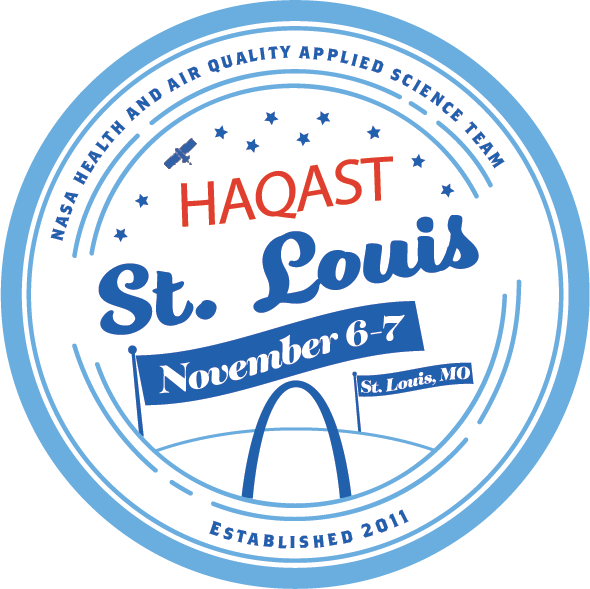
Save the date and meet us in St. Louis! We are planning an upcoming hybrid meeting November 6-7, 2025 in St. Louis, Missouri and online. This public meeting offers an opportunity to meet our new team members and learn about new applied research directions of this 2025-2029 HAQAST team. As always, we design our meetings to grow connections between stakeholders and scientists in the air quality, public health and satellite data communities, build two-way dialogue on ideas and initiatives, share new data and tools, and build professional networks We hope to see you there!
Registration is free, and you can register here.
If you are interested in presenting, please indicate on your registration.
We may have some funds available to support stakeholder travel--see eligibility criteria and the application here.
|
|
|
|
|
|
Upcoming Meetings and Events of Interest
- Ongoing, self-paced - ARSET Fundamentals of Remote Sensing.
- August 11 - 15: AmeriGEO Week, in Bogota, Colombia and online. See more here. This free event will be held in-person in National University of Colombia, and online, with simultaneous English/Spanish translation. Abstracts for the the in-person and virtual poster session are due August 6th. Select the “Public Health Surveillance” category to share research using Earth observations for health decision-making activities. Register here, and call for posters available in English and Spanish.
- August 19 - 22: Joint TEMPO/ACX Science Team Meeting - Learn more here.
- September 9 - 10: NASA's Prediction of Worldwide Energy Resources (POWER) Global Community Summit. The free, virtual event is empower attendees to learn about POWER's data offerings, engage with project leaders and the community. There are opportunities to submit lightning talks. Learn more here.
- September 25: IGAC-iCACGP Early Career Researcher online conference - International Commission on Atmospheric Chemistry and Global Pollution (iCACGP) Symposium and 18th International Global Atmospheric Chemistry (IGAC) invites all to register for this free online meeting. Abstracts are due August 10th. Six poster prizes will be awarded which will support transport and accommodation to the joint iCACGP-IGAC science conference in Crete, Greece, in September 2026. Learn more here.
- October 6 - 29: NOAASatHack: The NOAA Satellites Hackathon invites undergraduate and graduate college students to participate in this virtual event. The challenge is for students to develop a public awareness campaign about an environmental hazard by connecting NOAA satellite data to neighborhood level impacts. Students do not need to know how to code to apply. The application deadline is September 12th. Learn more here!
- October 7 - 9: AfriGEO Symposium. This year's theme is "From Data to Impact: Strengthening Africa’s Geospatial Future" and the meeting will be held in Dakar, Senegal. The registration deadline is August 31. Learn more here.
- November 6 - 7: HAQAST St. Louis. Find more information here. This free, hybrid event brings together researchers and stakeholders in public health, air quality, and satellite data. Register here.
- December 15 - 19: American Geophysical Union (AGU25) - Abstracts are due July 30th. If you are looking for session to submit to, consider submitting an abstract to GH001: Actionable Uses of Satellite Observations for Health and Air Quality.
- January 25 - 29: American Meteorological Society (AMS) Annual Meeting 2026. Abstracts are due August 14. Consider submitting an abstract to Benefitting Decision Support Tools using Earth Science Data session (part of the AMS 17th Conference on Environment and Health).
|
|
|
Internships and Jobs
If you are hiring, please feel free to share via email or LinkedIn – we’d love to help the community connect!
Postdoctoral Scholar Position in Aerosol Modeling and Remote Sensing
Dr. Jingqiu Mao is seeking a highly motivated postdoctoral scholar to join our research team studying aerosol modeling and remote sensing in northern high latitudes.
The successful candidate will work on projects related to high-latitude dust and wildfire smoke, using a combination of NASA satellite products, ground-based observations, and chemical transport models to assess their impacts on surface air quality and public health. The postdoc will also have the opportunity to collaborate closely with scientists in the NASA Health and Air Quality Applied Sciences Team (HAQAST) community.
Qualifications:
- A Ph.D. in atmospheric science, environmental science, remote sensing, or a related field
- Experience with aerosol modeling and/or satellite data analysis
- Strong programming and data analysis skills
- Excellent written and verbal communication skills
To Apply:
Please email a CV and a brief paragraph describing your research interests to Dr. Jingqiu Mao at jmao2@alaska.edu. Applications will be reviewed on a rolling basis until the position is filled.
Job Boards
Here are a few of the jobs boards which often include opportunities relevant to the health, air quality and remote sensing communities.
|
|
|
Funding Opportunities
NASA has released the Research Opportunities in Space and Earth Sciences 2025 ( ROSES-2025). While the NASA Health and Air Quality does not have specific calls open (since HAQ and HAQAST proposals were solicited last year), we want to highlight some opportunities that may be of interest:
- Impactful and novel use of NASA earth observations and models for value-added applications, technology, and societal benefits (INNOVATE) – Up to $1M over three years for the development and demonstration for EO tools and applications to meet a specific operational need of a third-party end-user organization. Data acquired through the NASA Commercial Satellite Data Acquisition program (including GHGSat data) may be used. Proposals can be submitted any time until March 31, 2026.
- Rapid response and novel research in Earth science (RRNES) – An unfunded catch-all program element that is intended to identify either time-sensitive research in response to an immediate and unforeseen event in the Earth system, or an exceptionally novel or innovative idea in Earth science that is not currently supported by another program element. Again, this program element is not funded itself but would instead attempt to match proposals with potential funding from other programs.
|
|
|
Call for Manuscripts
- TEMPO Data Products, Science and Applications. This special collection (JGR: Atmospheres, Geophysical Research Letters, and Earth and Space Science) focuses on TEMPO data products, including their development, demonstration of societal benefits, usage through data assimilation or analysis to improve understanding Earth and atmospheric processes, and their synergy with other satellite data products. Submissions are due December 31, 2025. More here.
|
|
|
Data and Tools
Sub-Orbital Order Tool (SOOT)
The Sub-Orbital Order Tool, or SOOT, is a tool developed by the Atmospheric Science Data Center (ASDC) for handling data acquired from suborbital field campaigns that are archived at the ASDC. SOOT supports data discovery and accessibility for users interested in airborne and field campaign data and promotes suborbital research and analysis. SOOT offers a browse mode where you can browse freely between campaigns, and a search mode where you can search for data products via campaign, date, platform, and/or variable category. SOOT also provides a merge service to align data files to a common time base based on platform, collection date, and campaign. You can find the ASDC SOOT Interface here.
Ozonerates: Photochemically produced ozone (PO3) datasets, Python package, interactive map
Using bias-corrected HCHO and NO 2 retrievals along with other geophysical variables, this product generates PO₃ from OMI and TROPOMI data. The website also contains a Python package to predict PO₃, and an online interactive map to visualize the datasets.
One Month of Preliminary TEMPO Aerosol Products Now Available
These products were developed using NOAA aerosol algorithms. The aerosol products are available for the sunlit portion of the TEMPO Field of Regard. This is an initial, targeted release to test the potential of the products for research and applications and to obtain feedback from known users of satellite aerosol products. NOAA will transition the final versions of the products to operations for general release when they reach “fully validated” product maturity status, with the plan to provide August 2023 - December 2024 aerosol products through NASA Earthdata.
For questions about the TEMPO Aerosol products, please contact Hai.Zhang@noaa.gov, Pub.Ciren@noaa.gov, or Amy.Huff@noaa.gov and copy Shobha.Kondragunta@noaa.gov.
Using Satellite Data for Volcanic Plumes
The COMET Program is pleased to announce the publication of the new lesson, " Ash and SO2 RGB Satellite Imagery Analysis for Volcanic Plumes”. This lesson highlights the use of the GOES-R Ash and SO2 RGB to assess the composition of volcanic plumes. The intended audience for "Ash and SO2 RGB Satellite Imagery Analysis for Volcanic Plumes” includes operational forecasters interested in practicing how the Ash and SO 2 RGB satellite products can be used to analyze the emissions of volcanic plumes. Resources for more information are provided at the end of the lesson.
MAIA Surface Monitor Data Product
The NASA Jet Propulsion Laboratory (JPL) Multi-Angle Imager for Aerosols (MAIA) project and NASA Langley's Atmospheric Science Data Center (ASDC) is excited to announce the release of the MAIA Surface Monitor Data Product. These products include ground-based measurements of total PM 2.5, total PM 10, and chemically speciated PM 2.5 at various locations within MAIA’s globally distributed set of Primary Target Areas (PTAs). Applications of these data include air quality, climate, and epidemiological research. Details about the sources of surface PM monitors used in the MAIA project can be found here. Learn more about the MAIA surface monitoring network here and access the PM and PM2.5 datasets.
Archived Datasets
If you are looking for data from retired federal websites, check out the Public Environmental Data Partners archive. The website includes the option to nominate data for preservation.
|
|
|
|
|
|
Other Opportunities
New NASA PolSIR Mission: The Polarized Submillimeter Ice-Cloud Radiometer ( PolSIR) is a new NASA satellite mission with the goal of understanding the influence of ice clouds on our dynamic planet. PolSIR is led by Ralf Bennartz at Vanderbilt University and Dong Wu at NASA Goddard Space Flight Center.
As the PolSIR mission is under development the Applications Team is beginning to engage with the community of science and applications stakeholders to document potential applications that amplify the benefit for PolSIR for operations, applications, decision-making, and policy. With PolSIR observing the diurnal cycle of ice clouds in the tropics and sub-tropics current applications themes include:
- Climate Modeling and Monitoring
- Numerical Weather Prediction, Data Assimilation, Model Validation and Parameterization
- Severe Storms, Tropical Convection, Hurricanes
- Lightning, Sprites, Jets
- Aviation Planning and Policy
If you are interested in hearing PolSIR Applications Updates and to receive invitations to Quarterly Applications Telecons and Workshops, please fill out this form to be added to the email list.
If you are interested in becoming a PolSIR Early Adopter, skip the interest form - go straight to the PolSIR Early Adopter Program form to say how you want to use PoLSIR data for an Early Adopter Project.
Project Phoenix: Project Phoenix is a community science monitoring project to study the effects of smoke on birds in neighborhoods across California, Oregon, and Washington. By observing birds in your neighborhood for just 10 minutes a week, you can help us learn more about bird responses to smoke. Learn more here.
|
|
|
|
|
|
Connect with HAQAST
We are always appreciative of your interest and involvement in the team. If you have colleagues who might also be interested, please invite them to sign up on our mailing list. You can also follow and connect with HAQAST on LinkedIn, or reach out personally with Tracey (taholloway@wisc.edu) and Jenny (bratburd@wisc.edu).
|
|
|
|
|