|
|
Celebrating a Cooperative Champion:
Margaret Bau
During this year’s Cooperative Network Summit and Annual Meeting, three exceptional leaders were honored with the 2025 Cooperative Builder Award—Cooperative Network’s highest recognition for advancing cooperative philosophy and ideals. Among them was Margaret Bau, longtime cooperative development specialist with USDA Rural Development, whose career has shaped the cooperative landscape not only in Wisconsin, but across the entire country.
|
|
|
|
Over more than three decades with USDA Rural Development, Margaret Bau helped launch over 40 cooperatives, trained more than 500 cooperative developers, and shared her expertise with nearly 10,000 conference participants. Introduced to cooperatives during her Peace Corps service in Costa Rica, she later earned a graduate degree in Community and Economic Development from the University of Minnesota. From her office in Stevens Point, she became a nationally sought-after cooperative development specialist, advising communities across the U.S. and Canada.
|
|
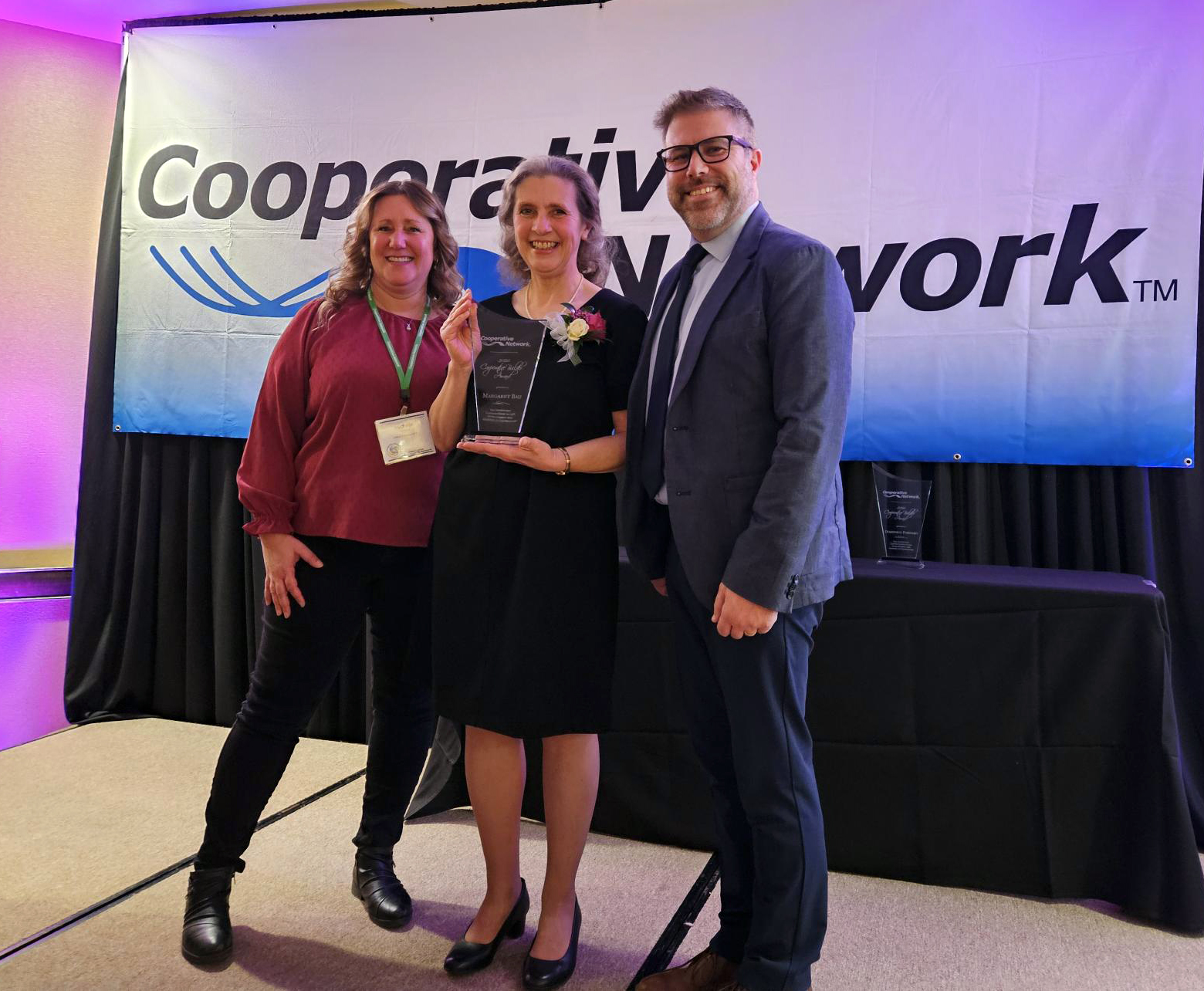
Margaret Bau receives the Co-op Builder Award from Cooperative Network Executive Director Ben Nelson and Board Member Michelle Gubster.
|
|
|
|
Margaret played a pivotal role in adapting the worker-owned homecare co-op model to rural Wisconsin, helping to found Cooperative Care in 2001—the first new worker-owned home care cooperative in 15 years. Her steady leadership helped grow the model to 25 cooperatives in 12 states. With experience spanning home care, forestry, grocery, and local foods, she is known for seamlessly integrating cooperative education and development. Her influence extends through national networks such as the Association of Cooperative Educators and CooperationWorks!, making her one of the most respected practitioners in the cooperative field.
At the UW Center for Cooperatives, we often say how lucky we are to have Margaret in Wisconsin. Members of our team have had the honor of being mentored by Margaret, working with her on a range of projects, and receiving her guidance and expertise through her participation in our advisory committee.
Congratulations to Margaret on the much deserved accolades!
|
|
|
|
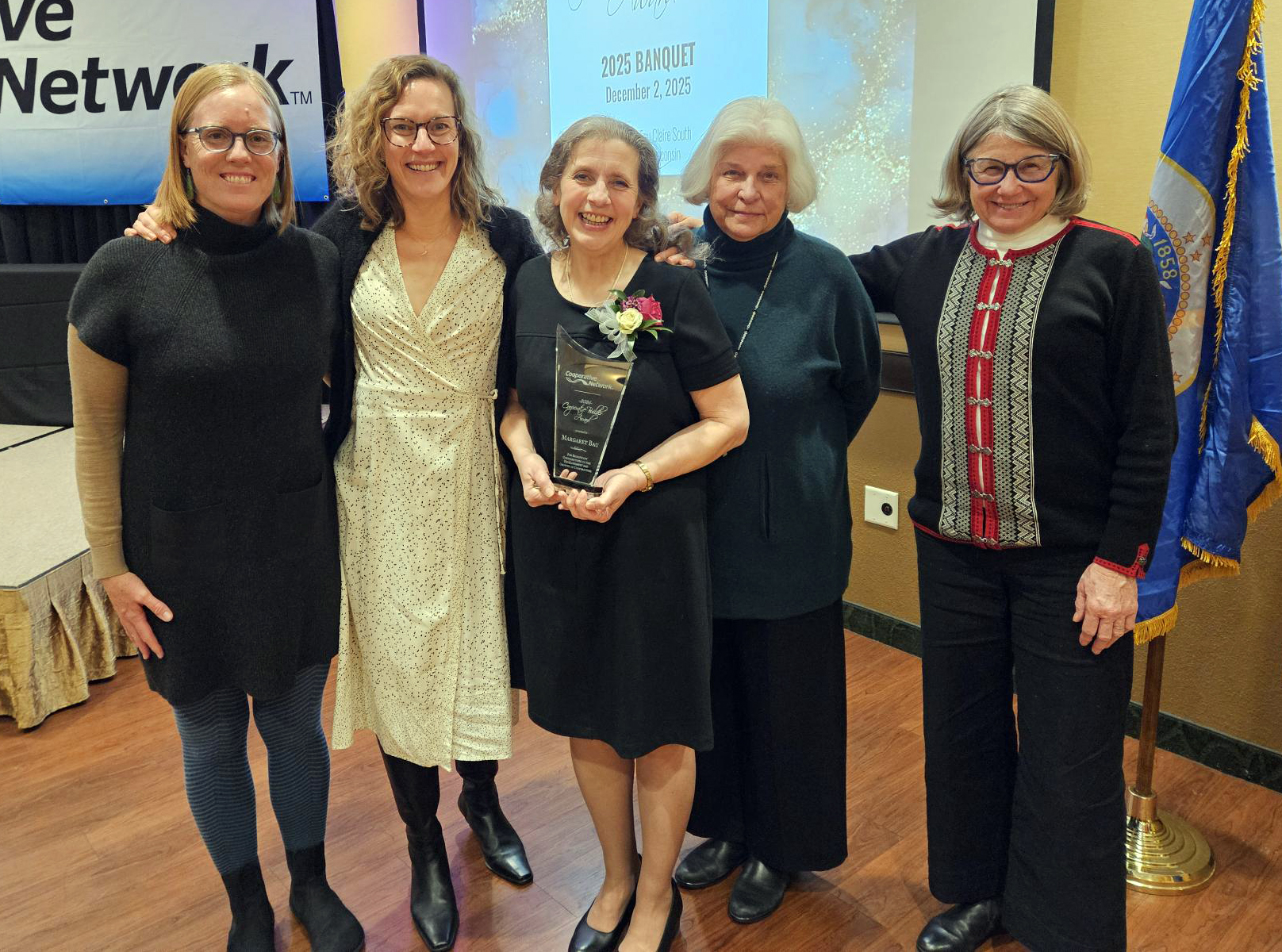
Margaret with Judy Ziewacz, former UWCC Executive Director Anne Reynolds, and UWCC staff members Courtney Berner and Kelly Maynard.
|
Three Cooperative Builder Awardees and soon to be Co-op Hall of Famers: Judy Ziewacz, Margaret Bau, and Anne Reynolds.
|
|
|
|
|
|
|
|
|
|
|
New Report Released: 2024 Cooperative Governance Research Initiative Findings (CGRI)
|
Launched in 2021, CGRI is a national, multi-year research effort designed to collect and analyze governance data from cooperatives of all types. The initiative was created to address a critical need: reliable, sector-wide information on how cooperatives govern themselves. By gathering data every three years, CGRI tracks trends and identifies opportunities for improvement in areas such as board composition, elections, training, and member engagement. The project is guided by three principles:
- Collaboration: Working closely with cooperative associations and practitioners to ensure research reflects real-world needs.
- Scientific rigor and practical utility: Collecting and analyzing data that are both credible and relevant for decision-making.
- Actionable insights: Translating findings into tools and resources that strengthen cooperative governance.
|
|
|
|
The 2024 CGRI report is based on the second round of data collection, with most measures and methodologies remaining consistent with those in the first survey conducted in 2021. Findings provide valuable insights for cooperatives seeking to enhance governance systems and align member priorities with organizational objectives. Key highlights include the following:
|
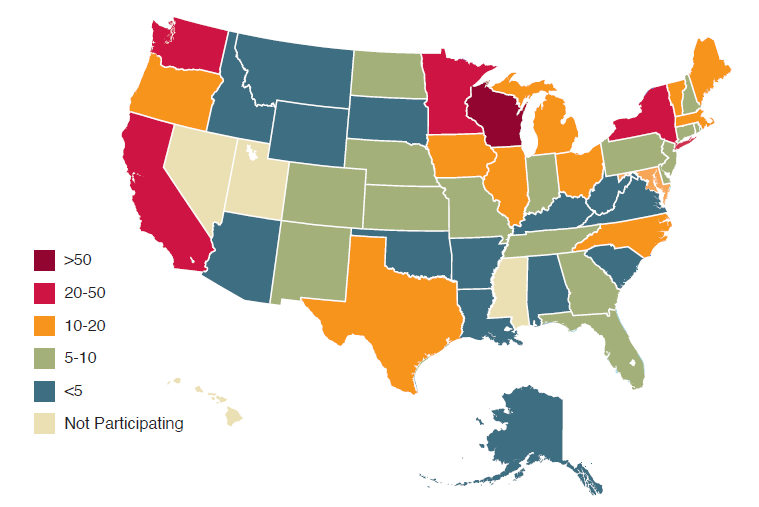
Participating Cooperatives by State
|
|
|
|
|
- Board Composition: Most cooperatives practice representative democracy, with board sizes ranging from 2 to 44 members (median: 8). Direct democracy is most common in worker cooperatives. Director diversity in age, gender, and race differs by cooperative type.
- Board Elections and Nominations: Most cooperatives elect their boards directly, and contested elections remain relatively rare. Nominating committees are common but vary in structure and function. They are primarily used to assess candidate eligibility and define recruitment priorities.
- Training and Evaluation: Basic director training and onboarding practices are widespread, but board evaluation lags. Forty-three percent of respondents never evaluate the board as a whole; evaluations of individual directors and committees are even less frequent.
- Meetings and Decision-Making: Agenda setting is collaborative, often by the board chair and CEO jointly (30 percent), or CEO with chair approval (18 percent). Board chairs lead most meetings (70 percent).
- Board Compensation: About half of cooperatives compensate board members, with insurance mutuals (95 percent) and producer/marketing cooperatives (82 percent) leading. Attendance-based per-meeting payments and fixed annual payments are the most common forms of director compensation.
- Management Practices: Most cooperatives (87 percent) have a CEO. Worker cooperatives often adopt collective or alternative management structures. Succession planning and performance evaluation practices are uneven across cooperatives.
- Member Participation: Member engagement is highest in worker cooperatives, based on turnout at the last board election and annual meeting. About 48 percent of respondents allow members to attend board meetings, with housing and multi-stakeholder cooperatives being the most open.
- Governance Effectiveness and Cooperative Performance: Boards are generally perceived as effective, with high ratings in strategic oversight and organizational performance. Reputation, member satisfaction, and delivery of value to members were rated highest among performance measures.
|
In the coming year, we plan to develop new tools and resources with CGRI data including a Trends Report that examines whether and how governance practices are changing over time and an online governance dashboard that will allow individual cooperative to compare their practices with other cooperatives.
To learn more about how you can support CGRI or to share an idea for a resource/tool, please email us at cgri@uwcc.wisc.edu. To stay in the loop about all things CGRI, including the release of the resources described above, subscribe for updates.
|
|
|
|
|
|
|
|
|
|
2026 Rural Co-op Development Funding Secured
|
|
|
|
Despite a high degree of uncertainty in the cooperative development funding landscape this year, UWCC has secured resources to continue our cooperative development programming in rural communities in 2026. Sources of support include two USDA Rural Cooperative Development Grants (RCDG) and three gifts from CoBank.
Due to changes in the administration of USDA’s Rural Cooperative Development Program, UWCC partnered with two organizations on RCDG grant applications instead of applying for the funds as a standalone organization. Our primary partner for delivering technical assistance to emerging cooperatives is Cooperative Development Services (CDS), a nonprofit that has served rural Wisconsin, Minnesota, and Iowa since 1985. This partnership builds on the longstanding relationship between UWCC and CDS, combining CDS’s expertise in value-added agriculture, rural grocery co-ops, and capital acquisition with UWCC’s strengths in multi-stakeholder cooperatives in agriculture and forestry, as well as facilitating business succession and employee ownership through co-op conversions. The collaboration leverages CDS’s tri-state regional reach and UWCC’s focused work in Wisconsin to deliver comprehensive coverage across all three states.
Our partnership with CDS is also deepening through a CoBank funded project to pursue replication of North Dakota’s successful employer led childcare cooperative in the upper Midwest. Over the coming year, we will work closely with CDS on a multi-phase project to engage rural and cooperative employers and explore the feasibility of developing employer-led childcare cooperatives in Wisconsin, Minnesota, and Iowa as a strategy for alleviating childcare and workforce challenges across the region.
With our RCDG funding from the Cooperative Development Foundation, we will leverage data from our Cooperative Governance Research Initiative (CGRI) to create new resources that developing cooperatives can use to help shape their governance structures and practices. We will also transform our Director Training Series, which is currently delivered in a hybrid format, to a more robust, fully virtual program that can be offered nationwide. These resources will support and inform cooperative developers and board members, who play a vital role in ensuring democratic governance within new and established cooperatives.
UWCC’s 2026 cooperative development funding is also being bolstered by CoBank’s Co-op Start Program, which provides grants up to $50,000 to emerging cooperatives as well as $25,000 to the co-op development organization supporting the cooperative. Two UWCC clients received Co-op Start grants in late 2025.
CoBank launched Co-op Start to help new agricultural cooperatives, but the program has evolved to meet the needs of emerging and innovative cooperatives beyond agriculture. In 2025, CoBank awarded a Co-op Start grant to a timber cooperative for the first time. The Timber Professionals Cooperative (TPC) was created by stakeholders across the forest
products value chain to rejuvenate Wisconsin’s forestry and wood product mill sectors. TPC helped launch Timber Professionals Cooperative Enterprises (TPCE), a logger and trucking cooperative that recently purchased a chip mill in Tilleda, Wisconsin, making it the first ever logger-owned chip mill in the country. TPCE plans to use their $50,000 Co-op Start grant to ensure compliance with Occupational Safety and Health Administration (OSHA) regulations as well as Sustainable Forest Initiative (SFI) and Forest Stewardship Council (FSC) standards.
The Southern Wisconsin Meat Cooperative (Meatsmith Co-op), another UWCC co-op development client, also secured a $50,000 Co-op Start Grant. Meatsmith Co-op is building local, niche meat processing infrastructure that will promote economic development and increase the resilience of the local food systemin southwestern Wisconsin. Once at full capacity, the co-op will directly employ 10-15 people, providing a living wage and benefits to all employees. By providing expanded access to humane on-farm livestock harvest and nose-to-tail meat processing, Meatsmith will help small- and medium-scale producers develop their on-farm enterprises, allowing many of them to increase production and farm revenue.
|
|
|
|
|
|
|
In Brief: Resources and Updates
|
|
Celebrating 40 Years of Cooperative Development Services
|
|
|
|
This year marks a major milestone for Cooperative Development Services (CDS)—40 years of strengthening cooperative enterprises across the Midwest and beyond. Since 1985, CDS has been a steadfast partner to food co-ops, farmer cooperatives, senior housing co-ops, and a wide range of member-owned enterprises striving to build local wealth and resilient communities.
Founded with a mission to help cooperatives start, grow, and thrive, CDS has provided technical assistance, business planning, and strategic guidance to hundreds of co-ops over the past four decades. Their work has supported everything from rural economic development to innovative models in sustainable agriculture and community-based care for older adults.
|
|
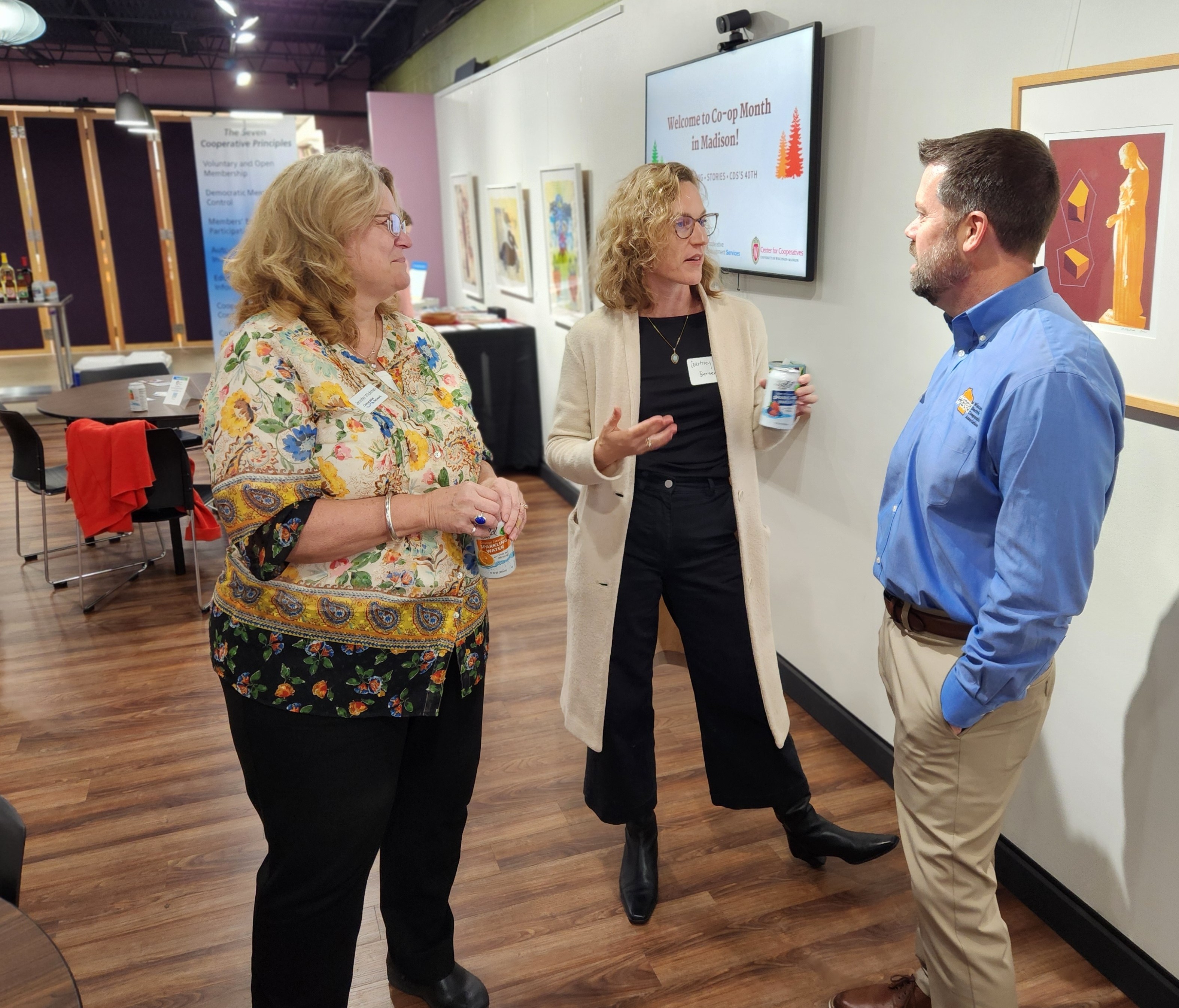
Jennifer Wickman from Cooperative Network, Courtney Berner from UWCC, and Rob Richard from Wisconsin Electric Cooperative Association.
|
|
|
|
This fall, UWCC was thrilled to co-host CDS’s 40th Birthday Party in Madison, WI, one of four celebratory events held across Wisconsin and Minnesota. The gathering brought together influential figures from CDS’s history—including its first executive director E.G. Nadeau, longtime co-op educator Anne Hoyt, and cooperative leader Judy Ziewacz—to honor the organization’s enduring impact.
Even more importantly, CDS is looking ahead to its next chapter, supporting a new generation of cooperatives working to address today’s economic, social, and environmental challenges. Congratulations to Cooperative Development Services on 40 years of building community power through cooperation.
|
|
Forestry Grants available
|
UWCC is pleased to invite proposals to receive $5,000 to $25,000 to fund the development of Wisconsin-based cooperatives or cooperative groups (e.g., associations, networks, and informal collaborations) in the following areas: forest management, forest-related products, biomass energy, forest-owner policy initiatives, and support for existing forestry cooperatives or associations. Proposals must be submitted by February 16, 2026. See the announcement and application for more details.
|
|
|
|
4th Credit Union Research Workshop
January 30th, 2026, 10 a.m. to 1 p.m. CT
Zoom
This event aims to foster collaboration, encourage meaningful dialogue, and share research focused on credit unions. An expanding body of research highlights key differences between credit unions and banks in areas such as risk management, loan pricing, executive compensation, responses to financial crises, and customer service.
|
|
|
|
Training for New Employees of Cooperatives
April 22, 2026, 9:30 a.m. - 11:00 a.m.
April 29, 2026, 9:30 a.m. - 11:00 a.m.
Zoom
|
|
|
|
This training is designed for employees of cooperatives seeking to deepen their understanding of the cooperative model. By the end of this training, attendees will have a stronger grasp of the cooperative identity and its impact on communities and economies.
This training is only for cooperatives based in Wisconsin.
|
|
|
|
|
|
CCMA 2026
May 28-30, 2026
Tacoma, WA
Join food cooperative directors, management, staff, and sector allies for a conference focused on highlighting issues impacting the cooperative movement.
|
|
|
|
|