
|
|
|
As November unfolds, we enter Gashkadino-giizis—the Freezing Moon in Ojibwemowin. Across the Great Lakes, Autumn is lingering later than usual this year. Because of the warmer temperatures, the maples and oaks are just now reaching their peak color, filling the landscape with shades of copper, gold, and crimson. In Madison, the nights have turned chilly, but the days still carry a touch of warmth, reminding us how change can arrive gently.
This in-between time invites us to notice—the smell of leaves and woodsmoke in the air, the way light stretches differently across the water, the quiet signal that transformation is both near and already here. Nature’s rhythm reminds us that transition itself is sacred: even in times of transition, beauty and our connection to the Earth and each other continue to need tending. The Freezing Moon calls us to ground more deeply in our connection with the living world, to listen closely for its quiet teachings, and to carry that wisdom into our relationships, work, and spiritual practice.
I recently took some time off so that I could submerge myself in the Indian Ocean and spend my days underwater watching hawksbill and green turtles foraging on sponges and seagrass beds, swim in between playful manta rays, snorkel in coral reefs, and simply live in the moment, breathing in and out according to the rhythm of the Earth. Maybe because I spent the most formative years of my childhood in rural Sikkim or because I spent a decade and half in field conservation, wilderness has always been my safe space. Wilderness is where I run to when in crisis or doubt. It is what I use to mend the cracks in my heart and grow the new skin on what is abraded. It is how my sense of self expands and evaporates until there is nothing left of boundaries between myself and the world. It is how I fill my cup when I’ve emptied myself out.
As it turns out, I’m not the only one; many of us experience greater happiness and life satisfaction while enjoying Nature! We do not need to leave the Earth to experience what has been described as the “Overview Effect”, the awe and self-transcendence that astronauts experience while viewing the Earth from space. We just need to remember that of the thousands of exo-planets that we know of, our planet is the only one which harbors Life. (In case you’re wondering, the secret lies in the abundance of water she holds; big complex organisms first evolved in the dark deep oceans after all.) Moreover, all of her operating systems; the water, nitrogen, and carbon cycles that are the foundations of life; co-exist in perfect interdependence. This allows Life to exist in complex yet sustainable ways all across the planet in different climates and geographies, where water, food, medicine, and the materials we need to house and clothe ourselves are abundantly made available to us in Nature, for free.
It takes us humans to turn them into commodities and to make them so expensive that they become unattainable to vast parts of our population. It takes us humans to create economic and government systems that are authoritarian, oligarchic, and crony capitalist, which weaken the institutions of democracy – freedom of speech, freedom of religion, voting rights, freedom from unwarranted governmental deprivation of the right to life and liberty, and minority rights to name a few - everywhere. Yes, it is happening everywhere. This is the year after all where the number of autocracies (91) has surpassed the number of democracies (88) globally. And, yet - the need to weaken democracy has been an elite opinion since at least 1975, when Crozier, Huntington, and Watanuki wrote the Crisis of Democracy report, arguing that an excess of democracy creates an imbalance as historically minority member groups of a population assert too many demands for their rights. Despite how it may feel, none of what we are experiencing is new.
Returning to the Great Lakes region, I’ve had to acclimatize to the chill in the night even as the days still carry a touch of warmth. This in-between period as we go from Autumn to Winter is an opportunity to breathe with the possibilities of transformation. The Earth’s seasonal rhythm reminds us that transition is natural and full of opportunity: it is in times of transition, not stagnance, that we grow the most. The seed of evolution rests in the depths of our core and we are always capable of becoming more - the Earth shows us how.
As we move closer to winter in the northern hemisphere, may we remember that our connection with the Earth and one another grows strongest when we take time to slow ourselves down, listen to one another, and be open to change.
|
|
|

|
Dekila Chungyalpa
Director, the Loka Initiative at the Center for Healthy Minds
University of Wisconsin–Madison
|
|
|
|
LOKA INITIATIVE NEWS AND UPDATES
|
|
|
|
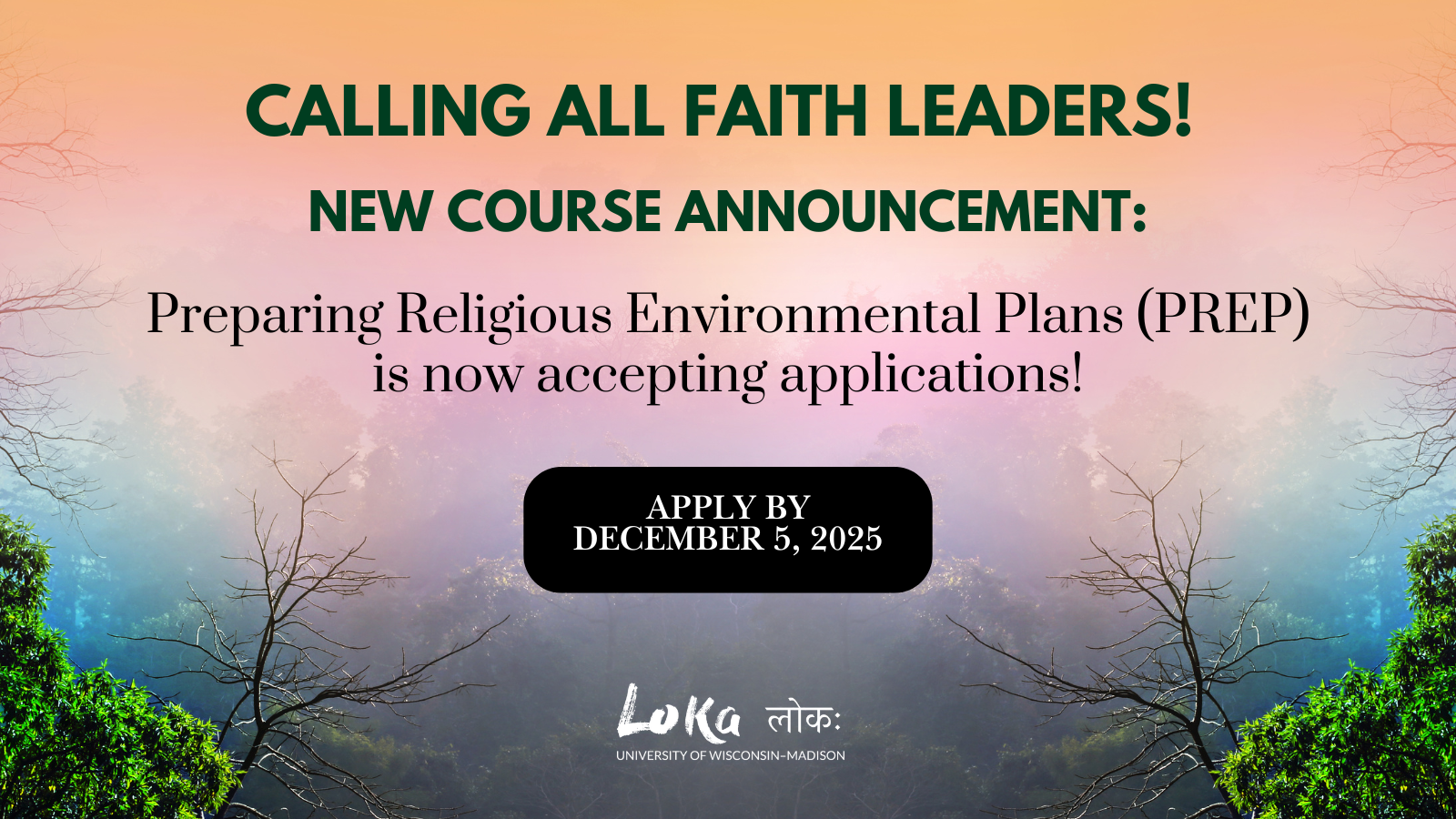
Loka’s newest course offering, Preparing Religious Environmental Plans (PREP), is now accepting applications! If you are a faith leader committed to healing our planet, don’t miss this unique chance to join a global community of like-minded individuals. This dynamic 10-week online course offers lectures, readings, discussions, and live instructor interaction. Starting January 5, 2026, this free online experience will weave environmental science with the deep wisdom of diverse religious traditions. Cohort members will be invited to Madison, Wisconsin to an all-expenses-paid, in-person gathering in March 2026.
Through this course, faith leaders will:
Gain practical skills needed to design and manage a real-world environmental project plan specific to your community's needs.
Be in community with like minded leaders from various faiths and traditions, and partake in a faith-based “homeroom” with peers who share your tradition.
Gather in March 2026 for an all-expenses-paid gathering in Madison, Wisconsin, which will: 1) provide crucial, specialized training in areas like project design, media outreach and fundraising to help you make your project a reality; 2) further link you to your global community of PREP classmates and experts in your fields.
We are profoundly excited to offer this unique opportunity. Space is limited to ensure a meaningful experience. To be considered for a spot, please submit your application form by December 15.
|
|
|
|
|
|
|
|

|
|
|
Date: Thursday, December 4, 2025
Time: 6:30 p.m. - 9:00 p.m.
Location: UW Science Hall, 550 North Park St. Madison, WI 53706
Each year during the week of November 30, communities around the world gather for Remembrance Day for Lost Species—a time to honor the beings and ecosystems we’ve lost and to renew our commitment to protecting the life that remains. This year, UW’s Nelson Institute for Environmental Studies and the Wisconsin Chapter of Physicians, Health Professionals and Concerned Citizens for Social Responsibility (PSR-WI) have organized a special event for the Madison community. Join Dekila, along with Dean Paul Robbins, Dr. Jonathan Patz, and more for an evening of reflection, learning, and action as we explore how land use, rewilding, and climate change shape species survival. Together, we’ll remember what has been lost, deepen our understanding of the extinction crisis, and envision the steps—both local and global—that can foster a more hopeful, life-sustaining future.
This event is free and open to the public:
|
|
|
|
|
|
Share Updates & Stay Connected!
|
|
|
|
|
|
Hashtags: #LokaInitiative #Loka🌎
|
|
|
|
Loka is an interdisciplinary collaboration among different programs at the University of Wisconsin–Madison. It is housed in the Center for Healthy Minds in collaboration with:
The opinions expressed here are solely the author’s and don’t reflect the opinions or beliefs of
UW-Madison, the Center for Healthy Minds or their affiliates.
|
|
|
|
|